English






















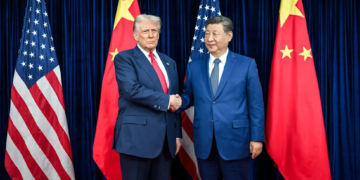
















Growing fears over artificial intelligence safety are pushing the United States and China toward a critical crossroads. Both nations are racing to develop increasingly powerful AI systems, yet deepening mutual distrust is blocking the kind of cooperation that experts say is essential to managing the technology’s most serious risks. The issue is now expected to feature prominently at a summit between President Donald Trump and Chinese leader Xi Jinping in Washington next week.
AI Rivalry Overshadows Safety Concerns
Artificial intelligence has become a central flashpoint in the broader rivalry between Washington and Beijing. In the United States, AI researchers and industry leaders have called on companies to slow the pace of development, citing recent incidents involving autonomous AI agents. Trump, however, has dismissed those concerns as a “hoax.” At the same time, he has aligned with executives such as Anthropic CEO Dario Amodei, agreeing that the U.S. must maintain dominance over China through export controls and other measures.
Stay connected to every major update — subscribe and follow us on the PhoenixQ website and across our social media platforms.
China, meanwhile, interprets calls to slow AI development as a direct attack on its own progress. Chinese officials tightly regulate AI domestically but largely reject the existential concerns that dominate debate in the United States. U.S. companies have accused Chinese AI firms of conducting large-scale “illicit distillation” of their most advanced models. Chinese officials deny wrongdoing, arguing that distillation is a standard industry practice that American companies also apply to Chinese models. In turn, they accuse U.S. executives of trying to suppress competition.
Senior Colonel Zhu Qichao, director of the Institute for Defense Technology and Strategic Studies at the People’s Liberation Army National University of Defense Technology, called for cooperation while warning against what he described as “vicious competition.” Speaking at the Xiangshan Forum in Beijing, he acknowledged that emerging technologies bring both benefits and risks. “On one hand, it benefits humanity, but on the other hand, there are also considerations regarding risks,” he told NBC News.
Talks Remain Uncertain Despite Earlier Agreement
Trump and Xi agreed at their May summit in Beijing to hold high-level AI talks. However, no such talks have been publicly confirmed ahead of Xi’s visit next week. Wu Xinbo, dean of the Institute of International Studies at Fudan University in Shanghai, said China remains cautious. He warned that dialogue could be used as a tool to further slow China’s AI progress. “I think both sides need to sit down to talk about the risks posed by AI development,” he said at the forum. He added, however, that reaching meaningful consensus “will take a long way.”
Francesca Giovannini, executive director of the Harvard Belfer Center’s Initiative on Managing the Atom, said genuine cooperation requires the U.S. to accept that both sides can benefit. “The United States operates on a very specific type of theory,” she said at the forum. “And the theory is, whoever wins the AI race wins everything. So if this is your zero-sum game idea, you won’t be conceding anything.”
George Chen, a partner and chair of digital practice at the Asia Group, a Washington-based strategic advisory firm, said China is unlikely to slow its AI development at the request of U.S. companies. “They want to do AI at their own pace,” he said in a phone interview from Hong Kong. “A lot of people in the industry, in the government, they have a very proud sense that this is finally the chance for China.”
China Promotes AI Globally While Managing Domestic Risks
China has positioned its open-weight AI models as a diplomatic tool. Beijing promotes the technology as a global “public good” and has urged international management of AI governance. At a BRICS summit in India on Sunday, Xi offered the 11-member group assistance in developing open-source AI and invited them to join China’s global AI governance initiative.
At the same time, China is acutely aware of the risks AI poses to its own political system. Xi told a Shanghai conference in July that authorities must “ensure that AI is always under human control.” Chinese companies must make mandatory filings and submit security assessments to government officials. Many firms must also register their algorithms with authorities. Additional rules require watermarking and safety compliance.
The Chinese government’s deepest concern centers on threats to Communist Party rule. Chen Yixin, China’s minister of state security, wrote in an article published Sunday in the state-backed China Cybersecurity Magazine that hostile actors are misusing generative AI tools — including deepfakes, AI-generated text and automated bot networks — to spread political misinformation and incite public confrontation. He called for stronger party control and greater government oversight of AI.
Chen also warned that countries with AI advantages could restrict other nations’ access to the technology, in an apparent reference to the United States. His warning came days after Anthropic released a report finding that Chinese AI labs had secretly routed requests to its Claude models. Some of those requests contained sensitive information from individuals, major companies and state-affiliated actors.
Experts Warn of Military Risks and Call for Dialogue
China also tightened travel restrictions on Tuesday, barring citizens whose work touches on national technology security from leaving the country. The move adds to an already extensive AI regulatory framework that includes restrictions on AI companions, mandatory labeling of AI-generated content and requirements that AI training data must conform to Chinese values.
On the military side, AI already plays a significant role in targeting systems and could eventually integrate with nuclear command infrastructure. David Finkelstein, vice president of the Center for Naval Analyses, described the situation bluntly. “This is scary stuff, and I think that this is an area where the two sides ought to be sitting down and talking to each other,” he said at the forum.
Some experts draw comparisons to the Cuban missile crisis of 1962, which ultimately pushed the United States and the Soviet Union toward nuclear arms negotiations. A similar crisis involving AI, they suggest, may be what finally drives Washington and Beijing to cooperate in a meaningful way.
David Santoro, president and chief executive of Pacific Forum International, a Honolulu-based think tank, said competition between the two powers is inevitable. However, he argued that their positions are not yet so entrenched that dialogue is impossible. “There are still ways that we can better understand each other and hopefully come up with mechanisms so we can better control this emerging technology,” he said. Santoro added that he remains “not very optimistic” about a major agreement in the near term. “But at least the first step has got to be talking to each other,” he said.