English























“By:Arash Parsa-Analyst and Researcher”
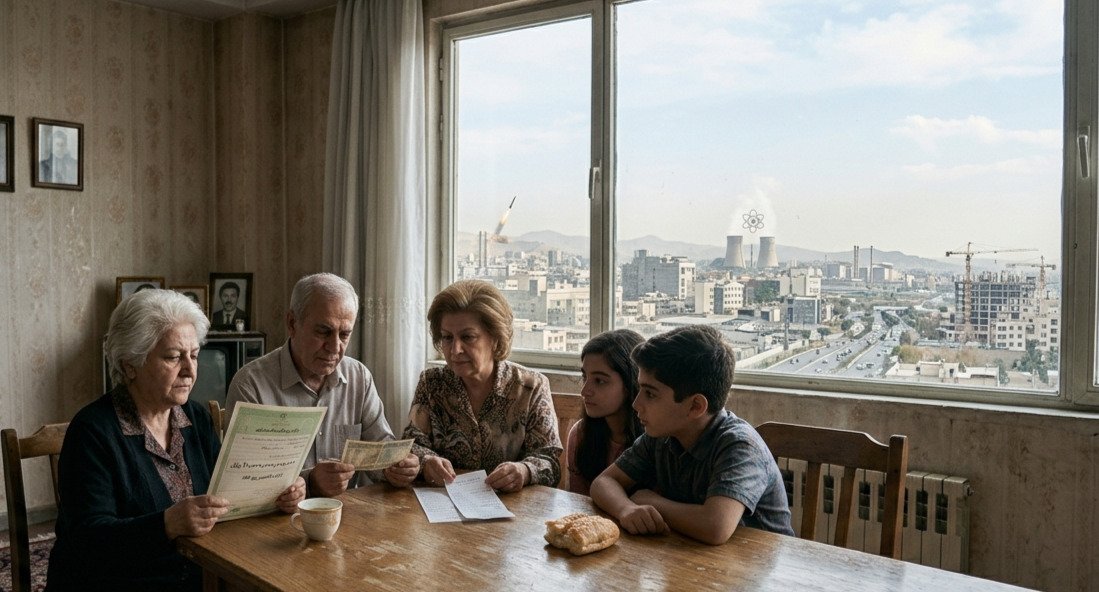
Consider a family that purchased a home for 100 million tomans 20 years ago. Today, that same property could be worth several billion tomans. At first glance, the family appears much richer. However, the family’s real wealth depends on what that property can buy today. If housing prices, food, healthcare, education, transportation, and other expenses have increased at the same time, selling the house may not allow the family to purchase a comparable property. This is the central paradox behind Iranians Billionaires on Paper. Asset prices can rise sharply while real living standards remain unchanged or even decline. A larger number on a bank account or property deed does not necessarily mean greater prosperity. Sometimes people are simply living the same life with much larger numbers.
Income Versus Inflation in Iran
The problem facing the Iranian economy is not simply rising prices. The deeper problem is the growing gap between income and the cost of living. When food, housing, healthcare, education, transportation, and other essential goods become more expensive, wages often fail to increase at the same pace. As a result, households lose purchasing power. Workers and employees may receive higher salaries every year, but if prices rise faster than their income, their real earnings decline. This forces families to reduce spending, postpone major purchases, and sometimes use their savings to cover basic expenses. For many households, managing money has become a constant race between income and inflation. This is another reason why Iranians: Billionaires on Paper, Poor in Reality captures an important feature of the country’s economic reality.
“Stay connected to every major update — subscribe and follow us on the PhoenixQ website and across our social media platforms.”
Why Do Prices Keep Rising?
Inflation does not affect consumers alone. Small businesses also face enormous pressure to preserve the value of their capital. Imagine a shopkeeper who buys a product for 10 tomans and sells it for 11. If the wholesale price rises to 13 tomans the following day, the shopkeeper cannot replace the product with the money received from the previous sale. The apparent profit has therefore become a real loss. To continue operating, the shopkeeper has to increase the selling price. The supplier may also raise prices because its own production and replacement costs have increased. This creates a cycle of higher costs, higher wholesale prices, higher retail prices, and lower purchasing power. In an inflationary economy, a higher selling price does not always represent higher profits. Sometimes businesses are simply trying to protect the value of their working capital. Ultimately, consumers absorb much of the cost.
Military and Security Spending
The economic challenges facing Iran also raise questions about government spending priorities. Iran allocates significant resources to its military and security structures, including defense programs, military equipment, missile development, drones, and other security-related activities. Every country must spend money on national defense and security. The economic question, however, concerns the scale of these expenditures and their opportunity cost. When public resources are limited, money allocated to one sector cannot be spent simultaneously on another. This means government spending decisions can affect the resources available for healthcare, education, infrastructure, housing, and social welfare. For a population already experiencing high inflation and declining purchasing power, these budget priorities become particularly important.
The Economic Cost of Iran’s Nuclear Program
Iran’s nuclear program has generated direct and indirect economic costs over several decades. The development and maintenance of nuclear facilities require financial resources, infrastructure, technology, and specialized personnel. However, the economic consequences extend beyond direct government spending. Disputes surrounding Iran’s nuclear activities have contributed to international sanctions that have affected foreign trade, oil revenues, banking transactions, investment, and access to international markets. These restrictions have increased the cost of doing business and made it more difficult for Iran to attract foreign investment. As a result, the economic cost associated with the nuclear issue cannot be measured solely by the official budget allocated to nuclear facilities.
The Cost of Regional Proxy Groups
Another controversial economic issue is Iran’s support for allied armed groups across the Middle East. Such support can include financial assistance, weapons, equipment, military training, and logistical support. The precise cost is difficult to determine. Different governments, research organizations, and analysts have produced widely different estimates. For that reason, assigning one definitive figure to Iran’s total regional expenditures would be misleading. Nevertheless, the economic principle is clear: resources allocated to external activities cannot be used for domestic purposes at the same time. This becomes especially significant when the government faces budget deficits while households struggle with inflation and declining purchasing power.
The Cost of Domestic Repression
Economic pressure is also connected to the cost of maintaining domestic security structures. Security forces, policing, detention systems, judicial processes, surveillance, and the management of large-scale protests all require financial and human resources. Iran experienced major protests in 2017, 2019, and 2022. The November 2019 protests expanded after the government sharply increased gasoline prices. Internet restrictions during the unrest also disrupted communication and economic activity. In 2022, nationwide demonstrations followed the death of Mahsa Amini. The resulting Woman, Life, Freedom movement produced widespread arrests, casualties, and significant political and social tensions. The economic consequences of unrest can extend well beyond direct government expenditures. Businesses may close, workers may lose income, internet restrictions can interrupt online commerce, and uncertainty can discourage investment.
Claims regarding the number of people killed during later protests, including claims of more than 60,000 deaths during protests in January 2026, have circulated in various reports and online sources. These figures remain disputed and should not be presented as confirmed statistics without independent verification. Regardless of the disputed figures, prolonged unrest can impose substantial economic costs on both the government and ordinary citizens.
Iran Is Rich in Natural Resources
Iran is not a resource-poor country. It has enormous oil and natural gas reserves, substantial mineral resources, agricultural land, and a strategically important geographic position connecting major markets in the Middle East and Asia. Iran also has a large and educated workforce. Human capital is one of the country’s most important economic assets. Yet natural resources alone do not guarantee prosperity. Countries become prosperous when resources are combined with effective institutions, investment, productivity, economic stability, transparency, and access to international markets.
For Iranians Billionaires on Paper, this creates a striking economic paradox. Iran possesses significant national wealth, but many households do not experience that wealth in their everyday lives. Natural resources can generate enormous revenues, but those revenues must be converted into productive investment, employment, infrastructure, and public services to improve living standards.
Sanctions and Economic Isolation
International sanctions have significantly affected Iran’s economy. Restrictions on banking, oil exports, international payments, trade, and foreign investment have made economic activity more expensive and complicated. At the same time, domestic economic policies, structural inefficiencies, currency instability, and weak investment have created additional challenges. The combination of external pressure and domestic economic problems has made sustainable economic growth more difficult. For ordinary Iranians, the result is often visible in the cost of food, housing, transportation, healthcare, and education.
When Government Spending Becomes Detached From Household Needs
The central issue is not whether a country should spend money on defense or security. Every government has legitimate security responsibilities. The more important question is how resources are prioritized when citizens are facing economic hardship. When inflation remains high and the national currency loses purchasing power, large government expenditures naturally attract greater public attention. Citizens want to know how much of the country’s oil revenues, tax income, and other national resources ultimately returns to improving their daily lives. If national revenues increase while household living standards fail to improve, the problem may not simply be a shortage of resources. The allocation of those resources must also be examined.
Economic Pressure Is Not the Only Problem
The hardships facing Iranians: Billionaires on Paper, Poor in Reality extend beyond household finances. Major protest movements in 2017, 2019, and 2022 reflected a combination of political, social, and economic grievances. Economic pressure played an important role in several of these movements. In 2019, a sudden increase in gasoline prices triggered widespread protests. Internet restrictions then made communication and commercial activity more difficult. In 2022, the death of Mahsa Amini sparked demonstrations across the country. The Woman, Life, Freedom movement brought together a broad range of social and political grievances. These events demonstrate that economic hardship does not exist in isolation. For many citizens, declining purchasing power, social restrictions, political tensions, and uncertainty about the future have become interconnected problems.
Where Is Iran’s Wealth?
This leads to the central question: If Iran possesses such extensive natural and human resources, why are so many people experiencing declining purchasing power? There is no single answer. Currency depreciation, persistent inflation, international sanctions, unstable economic policies, structural inefficiencies, and management problems have all contributed to the situation. Government spending priorities also deserve closer examination, particularly spending related to military, security, nuclear, and regional activities. However, without transparent and comprehensive financial data, it is difficult to determine precisely how much each factor contributes to the country’s economic difficulties. One fact is much easier to observe. For millions of Iranian households, rising nominal asset values have not translated into rising living standards.
The Paradox of Iranians: Billionaires on Paper, Poor in Reality
The phrase Iranians: Billionaires on Paper, Poor in Reality captures a fundamental contradiction in Iran’s economy. People can own properties worth billions of tomans and receive salaries measured in millions or even billions of rials. Yet the same people may struggle to afford housing, food, healthcare, education, and other basic necessities.
This is the difference between nominal wealth and real wealth. Nominal wealth is measured by the number printed on a bank statement, salary slip, or property document. Real wealth is measured by what that money can actually buy. When inflation rises faster than incomes and asset values, people may become richer in numbers while becoming poorer in purchasing power.
That is why Iranians Billionaires on Paper is more than a striking phrase. It describes an economic reality in which bigger numbers do not necessarily mean a better life. Iran’s challenge is therefore not simply to create more money or increase nominal asset values. The deeper challenge is to create stable purchasing power, sustainable economic growth, productive employment, and a system in which the country’s enormous resources translate into greater prosperity for ordinary people.