English







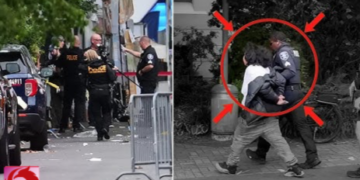


















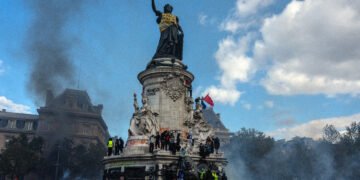




Fresh clashes erupted across France on Saturday as hundreds of thousands of people took to the streets in cost-of-living protests, exactly one week after a wave of riots left the country shaken. Police arrested nearly 1,000 people as Interior Minister Laurent Nuñez described an “extremely elevated level of violence” from black-clad “ultra-left” extremists. The renewed unrest tested President Emmanuel Macron’s efforts to restore order ahead of a presidential election in six months.
Mass Protests Draw Hundreds of Thousands
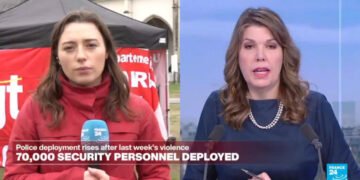
Saturday’s demonstrations drew between 410,000 and 800,000 people nationwide, according to estimates from authorities and the organising CGT union. The main Paris march alone attracted between 110,000 and 250,000 attendees. Authorities had deployed 70,000 security forces across the country in anticipation of the marches.
Stay connected to every major update — subscribe and follow us on the PhoenixQ website and across our social media platforms.
In Paris, the route shifted at the last minute to the city’s southeast rim. The main march there passed largely peacefully. However, clashes broke out as the crowd began to disperse, with Nuñez saying around 500 rioters at the back of the march engaged police in confrontations lasting two hours.
AFP journalists on the ground witnessed police charging repeatedly and using tear gas and batons against protesters, many of them young. One demonstrator, bleeding from a baton blow to his face and giving only his first name as David, told AFP: “The police started moving towards everyone, telling them to get down and back off. They were just taking people down, you know, beating protesters.”
Riot police fired tear gas in Paris, Marseille, Lyon, Bordeaux, Lille, Toulouse, Montpellier and Nantes. In Nantes, thousands of protesters broke through police lines and a water cannon barrier to reach the city centre. In Lyon, officers dispersed around 1,000 people gathered in the south of the city using tear gas.
Injuries, Looting and Far-Right Tensions
Two people suffered serious injuries during the day. One man in Toulouse reportedly had fingers blown off, and another person in Clermont-Ferrand was also seriously hurt. Nuñez did not provide further details on either case.
Police also reported looting on the sidelines of marches in Marseille and Grenoble. Meanwhile, in the southern cities of Cannes and Montpellier, far-right activists took to the streets seeking confrontations with what they called “ultra-left militants.” Authorities described this as an unprecedented development.
Nuñez nonetheless said Saturday’s overall outcome was more “positive” than the previous weekend. He pointed to a larger police presence, faster response times, more pre-demonstration checks and better protection of businesses.
The previous week’s rioting had seen public buildings vandalised, hundreds of shops looted and 2,700 people arrested. That violence cast a long shadow over a country preparing to choose Macron’s successor after his ten years in power.
Government Crackdown Fuels Anger
Macron’s government ordered police to keep protesters away from city centres, where shops are concentrated. Partial curfews were imposed in certain urban zones in Paris and some other cities. The president also banned non-union demonstrations, calling them “illegitimate.”
Those measures drew widespread anger. Many protesters and critics viewed the crackdown as an attack on the right to demonstrate. In Lyon, a 20-year-old protester who gave only his first name, Silem, said: “If they prohibit protests, then that means we are heading more and more towards a regime that is fascist, that is dictatorial.”
In Rennes, 23-year-old Emma said she was angry at “everything happening at the moment,” specifically denouncing the bans on demonstrations and what she called the “repression” of student protests. In Lille, 47-year-old Delphine marched through the rain and declared: “Neither the president, nor the weather will stop me from demonstrating.”
Far-left presidential candidate Jean-Luc Mélenchon, who marched in the Paris rally, warned that Macron “is going to understand that this is going to repeat itself every week.” The Yellow Vests movement, which staged major disruptive protests against Macron eight years ago, also called for further demonstrations on October 31 in support of the freedom to protest.
Le Pen Rally Adds to Political Tension
Political tensions rose further on Saturday as far-right leader Marine Le Pen’s National Rally party held a rally in Orléans to launch her presidential campaign. Thousands of counter-protesters marched through the city chanting anti-fascist slogans. Police estimated their number at 13,000, while organisers claimed twice as many participated.
Le Pen currently leads in presidential election surveys. The unrest across France underlined the volatile political mood ahead of the vote. Inflation, particularly the rising cost of fuel since the start of the Middle East war in February, has added to public frustration.
France is not alone in facing street unrest. Similar protests have taken place in Italy, Belgium, Spain and Portugal over a range of issues, including inflation and education. Italy deployed 500 troops to Milan after street violence there.