English











































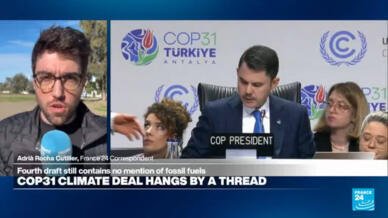
The COP31 climate summit collapsed into disarray on Sunday after the European Union refused to endorse a proposed final agreement that made no mention of fossil fuels. Ireland’s Climate and Energy Minister Darragh O’Brien, speaking on behalf of the EU presidency, told the closing session that member states would not accept any deal that ignored the primary driver of climate change.
EU Draws a Hard Line on Fossil Fuels
“We will not endorse a cover decision that does not even mention fossil fuels, which is the key driver of climate change,” O’Brien said. His statement drew a clear boundary for the bloc’s position. France went further, calling the latest draft text a “backward” step.
Stay connected to every major update — subscribe and follow us on the PhoenixQ website and across our social media platforms.
French Ecological Transition Minister Monique Barbut warned that time was running out. “The situation is difficult, and the outcome is uncertain,” she said. A German official added that oil-producing countries were putting up a fierce fight. Saudi Arabia declined to comment publicly.
Summit co-hosts Turkey and Australia released the proposed agreement deep into overtime. The text referenced a 2023 global deal to shift away from fossil fuels but stopped short of naming coal, oil or gas directly. It also retained a push to expand carbon capture and storage, a technology the fossil fuel industry supports but critics call costly and ineffective.
Developing Nations Express Frustration
The environment minister of Antigua and Barbuda, Michael Joseph, said he was deeply disappointed. “I can’t honestly say that I’m okay with it passing,” he told reporters after leaving the COP31 presidency’s offices. He described the draft as “quite silent” on fossil fuels.
Developing nations also expressed anger over the removal of a $120 billion climate adaptation funding target. Many argued that wealthier countries were failing their obligations to help poorer nations cope with climate change. Meanwhile, Saudi Arabia, India and Kenya faced criticism for attempting to delay the next round of reports from the UN’s Intergovernmental Panel on Climate Change.
Electrification Goal Remains in the Draft
Despite the disputes, the draft text retained a goal to raise electricity’s share of total final energy consumption to 35 percent by 2035. Turkey and Australia promoted electrification as a practical path to cutting emissions. However, some nations demanded explicit language ensuring that expanded electricity use would rely on renewable energy rather than fossil fuels.
Currently, around one-third of global electricity comes from coal and another fifth from fossil gas. The distinction matters greatly to countries pushing for genuinely clean energy targets.
The summit also failed to resolve disagreements over the 1.5 degrees Celsius warming limit set under the Paris Agreement. The draft expressed “deep concern” that global temperatures could breach that threshold within years. The talks took place against a backdrop of record-breaking climate disasters across Europe, Nepal and Indonesia, adding urgency to negotiations that ultimately ended without consensus.