English



































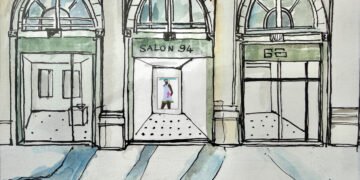
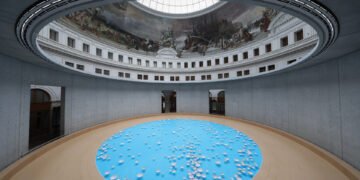








The 1-54 Contemporary African Art Fair returned to London this week for its 14th edition, bringing together a diverse range of artists from across Africa and its diaspora. This year’s fair introduced a new section called “West Wind,” curated by art historian Nancy Dantas and focused on African modernism. The section takes its name from Miriam Makeba’s 1966 anthem for unity and features mid-20th-century masters including Ibrahim El-Salahi, Bertina Lopes, and Seyni Awa Camara. It also directly responds to the gap left when Sotheby’s closed its dedicated African modernism department in 2025. The fair runs through Sunday at Somerset House.
Memory, Identity and Displacement
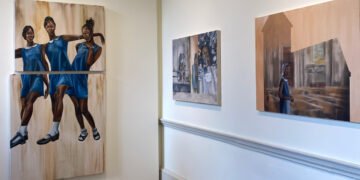
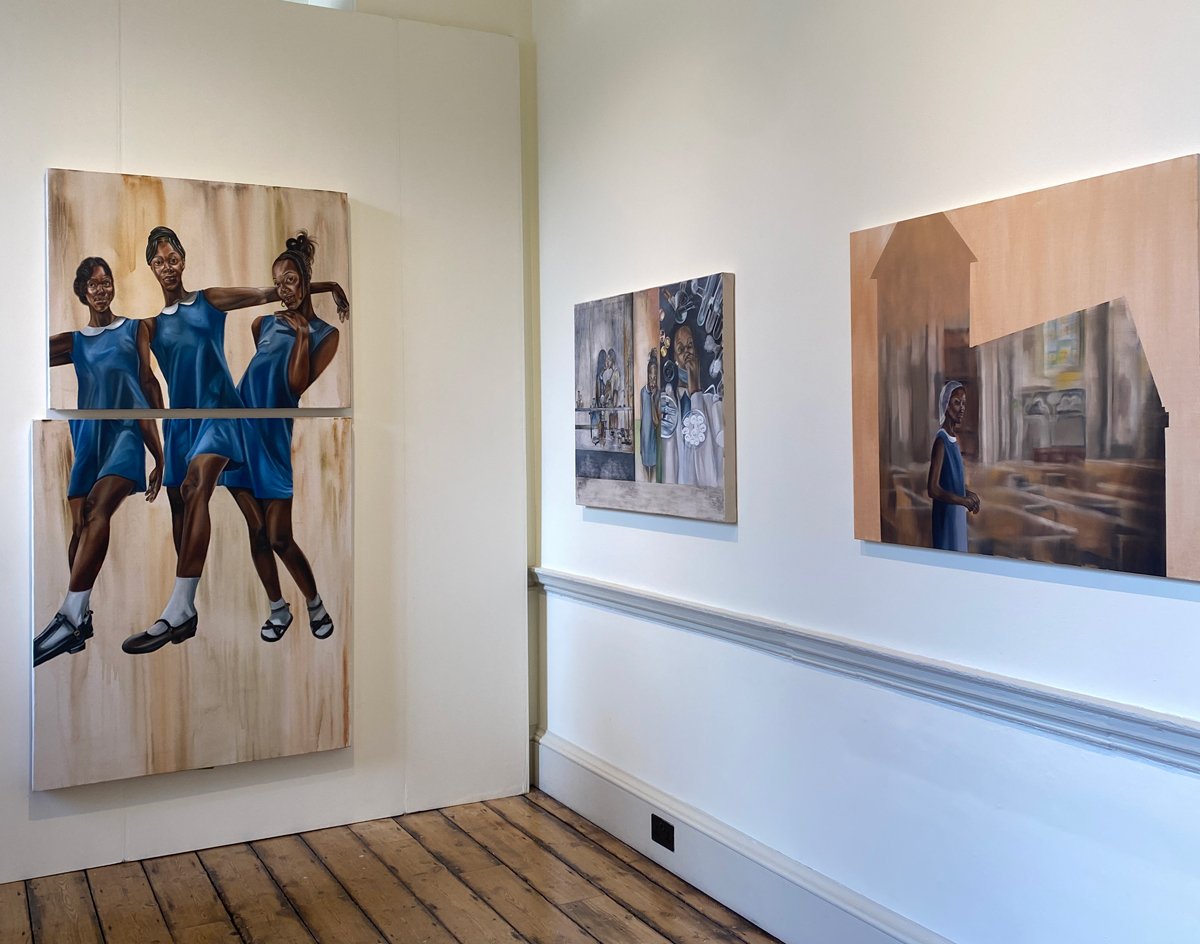
Among the standout presentations is Nigerian-born artist Ekene Emeka Maduka, shown by Fabienne Levy. Her seven oil-on-canvas paintings draw from her years at a Nigerian boarding school, building what she describes as a nostalgic “memory palace.” Her diptych Presence, Half-remembered (2026) depicts three schoolgirls and reflects on identity and displacement. Developed during a residency in Switzerland, the works contrast the human figure against postcolonial modernist architecture, positioning the school as a central character. Maduka also draws on literary references, placing William Golding’s Lord of the Flies alongside Chinua Achebe’s Things Fall Apart to examine the alienating structures of neo-colonized education.
Stay connected to every major update — subscribe and follow us on the PhoenixQ website and across our social media platforms.
At Yenwa Gallery, Lagos-based artist Damilola Opedun focuses on Makoko, a vulnerable waterfront community facing government demolitions and land reclamation. His two large paintings, The Sacred Between and The Center Between The Noise (both 2026), document the 2025 displacements while imagining a future where Makoko gains global recognition similar to Venice. Opedun blends lived experience with imaginative possibility, using blues and browns to create a bird’s-eye perspective. He intertwines Makoko’s floating structures with Venetian landmarks such as Santa Maria della Salute, using light and architecture to blur geographic boundaries.
Cape Town–based artist Buqaqawuli Nobakada, shown at Affinity Gallery, uses mixed-media painting to explore abundance and leisure for Black women. Her lace-on-canvas work Emcimbini (2026) depicts women lounging poolside and swimming freely. Having witnessed the socio-economic restrictions faced by previous generations, Nobakada projects those women into aspirational spaces of pleasure and freedom. She incorporates delicate lace into her canvases, framing manifestation not as an individual act but as a collective expansion of possibility.
Material Histories and Cultural Roots
Egyptian artist Medhat Shafik, presented by Errm Art Gallery, uses layered collage paintings as metaphors for fractures in contemporary society. Working like an archaeologist, he assembles what he calls “fragments” to help viewers reconnect with a shared identity. His centerpiece, Red (2025), features an asteroid hurtling toward Earth in a red-dominated composition. He builds his canvases from natural sand, teabags, and fabrics treated with Indian dyeing techniques, drawing inspiration from ancient Mediterranean, Middle Eastern, and Nile heritages.
Congolese artist Yvanovitch Mbaya, shown at Ablakassa, takes a different material approach. His large textile work Untitled (2023) dominates the booth and is crafted from recycled denim, the same fabric used to cover commercial transport trucks in his home region. Anonymous, genderless figures from the Bantu tribe appear across its surface. Mbaya infuses the denim with coffee and oil paint to create varied textures and an earthy presence. Also on view are two works on paper, reflecting his broader multidisciplinary practice and his academic background in art psychology.
South African ceramic artist Mellaney Roberts, shown at Berman Contemporary Gallery, transforms clay, glass, and metal into objects of remembrance. Originally from Willowmore in the Eastern Cape, she created three sculptures for the fair in response to devastating floods in May 2026 that destroyed ancestral lands belonging to marginalized Coloured and Khoi communities. Her standing sculpture Die Draers (The Bearers) (2026) integrates copper into cut and pierced ceramic surfaces, carrying a steampunk aesthetic. Roberts sources her materials locally, using clay, resin, and tree bark collected from her home region.
Technical Innovation and Collective Empowerment
Self-taught Nairobi-based artist Alpha Odhiambo, presented by 16/16, has spent years developing a distinctive painting method using industrial vinyl mesh. His multilayered work Bodybuilder (2026) demonstrates his precise technique of mixing acrylics and solvent paints to control pigment flow through the porous surface. The result shifts between opacity and translucency, resembling stained glass or holograms. The work also changes under different lighting conditions. Odhiambo draws from everyday imagery to examine global political structures and their impact on human lives.
London-based artist and interior architect Holly Rollins, shown at Gillian Jason Gallery, explores the domestic space as an archive of cultural memory. Her exhibition includes lamps, clay photo frames, and two chairs that blur the line between functional sculpture and fine art. At the center is the pink Kaymito Chair (2026), made from 3D-printed recycled plastic. Working under her studio ROLSTUDIO, Rollins draws from Caribbean matrifocal family structures and her academic research into neuro-architecture to create objects that reflect identity and intergenerational memory.
Cairo-based artist and art historian Souad Abdelrasoul, shown at Gallery Misr, uses surreal, metamorphosed figures to explore the tension between women and oppressive social systems. Her large-scale centerpiece A Memory Between Fear and Flowers (2026) depicts a psychological confrontation between a contemporary woman and a man in primitive clothing. He holds a rabbit, symbolizing unanalyzed fears and unchecked masculine authority. The woman holds a miniature mirror image of herself, representing maternal lineage and inherited resilience. Six smaller dual-aspect portraits also feature in her exhibition.
Finally, South African artist Kimathi Mafafo, shown at Kristin Hjellegjerde, presents seven intricate embroidered textile works that celebrate female empowerment through nature. She uses both hand and machine stitching, blending pink, purple, and brown tones to achieve rich skin textures. Collaboration is central to her practice. She works closely with women she has trained in her studio, weaving elements of their lives into each piece. Her work Clearly, A Flamboyant Alliance: A Flamboyant Collaboration (2023) features overlapping limbs that suggest bodies in motion. Drawing on childhood memories of botanical gardens, Mafafo also incorporates passion flowers into her tapestries, a calming bloom introduced to her by her grandmother for its restorative properties.