English
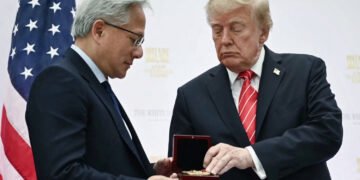















































Nvidia’s former chief executive Jensen Huang was widely seen as one of Europe’s most powerful allies in the race to build artificial intelligence infrastructure. However, with Huang now gone from the company, questions are growing about what his departure means for European AI ambitions.
Huang’s Support for European AI
During his time leading Nvidia, Huang invested heavily in open-source AI development. He directed significant funding toward Hugging Face, the French-founded AI platform that has become central to the global open-source AI community. He also supported chip supply for Mistral’s data centres, backing one of Europe’s most prominent AI startups.
Stay connected to every major update — subscribe and follow us on the PhoenixQ website and across our social media platforms.
Beyond financial investment, Huang actively pushed back against Washington’s efforts to restrict AI chip exports. Those restrictions threatened to limit Europe’s access to the advanced semiconductors needed to build competitive AI systems. His resistance to those policies made him a notable figure in debates over global AI access.
A Shift in Power at Nvidia
Huang’s departure has coincided with a broader shift inside Nvidia. China hawks within the company and across the wider US technology policy landscape have grown more influential. As a result, the export restriction debate is likely to intensify. Europe could find itself more exposed to supply limitations without Huang’s voice pushing against them.
Tech 24 has raised the question of whether Huang was ever truly the champion Europe needed. While his investments and policy positions benefited European AI development, his primary obligation was always to Nvidia’s commercial interests. Europe’s dependence on a single executive at a US chipmaker highlights a deeper vulnerability in the continent’s AI strategy.
Europe’s Broader AI Challenge
Europe has struggled to build fully independent AI infrastructure. The continent relies heavily on US-designed chips and US-based cloud platforms. Furthermore, regulatory uncertainty and fragmented investment across member states have slowed progress. The loss of a sympathetic figure at Nvidia’s helm adds another layer of difficulty.
Meanwhile, competition from the United States and China continues to accelerate. Both countries are investing at a scale that Europe has not yet matched. Without strong external allies and without greater internal coordination, European AI ambitions face serious headwinds in the years ahead.
The situation raises an urgent question for European policymakers. Rather than relying on the goodwill of foreign technology executives, the continent may need to build more self-sufficient AI capabilities. Huang’s exit serves as a reminder that external allies, however influential, can disappear quickly.