English




































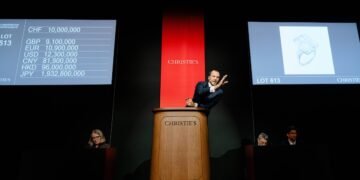









New York’s Whitney Museum is selling a Willem de Kooning painting at Christie’s just three years after formally receiving it as a gift from the family of a former museum president. The move has drawn attention to the institution’s growing use of deaccessioning as a collection strategy.
A Prized Painting Heads to Auction
The work, Yellow River (1958), is a large abstract canvas dominated by bold sweeps of blue and yellow. Christie’s will offer it in its 20th century evening sale on November 17, with an estimate of $12 million to $18 million. The museum plans to use the proceeds to benefit its collection.
Stay connected to every major update — subscribe and follow us on the PhoenixQ website and across our social media platforms.
The painting has a rich personal history. It belonged to David M. Solinger, a lawyer, collector, and the Whitney’s first president from outside the Whitney family, a role he took on in 1966. Solinger purchased the work from Sidney Janis Gallery in 1959. According to Christie’s, he valued it so deeply that it hung at the foot of his bed, where he could see it each morning.
After Solinger died in 1996, the painting passed to his wife, Betty Ann Besch Solinger. She pledged it to the Whitney in 2011, and the museum exhibited the work that same year. However, the gift was not formally completed until 2023, following her death in 2022. Now, just three years later, the painting is returning to the market.
Part of a Broader Deaccessioning Strategy
This is not the first time the Whitney has sold works from its permanent collection. In 2023, the museum sent several paintings to Sotheby’s, including works by Edward Hopper, Maurice Prendergast, and John Marin. Edward Hopper’s Cobb’s Barns, South Truro (1930–33) led that group, carrying an estimate of $8 million to $12 million.
At the time, Jane Panetta, then the Whitney’s curator and director of the collection, explained the reasoning behind the sales. “We’re always thinking about how one defines ‘the museum of American art,’ being mindful of wanting the collection to accurately represent the United States,” she told ARTnews. “We think that means the collection has to evolve. We have to try and close critical gaps, and having endowment funds for acquisitions is a key means to doing that.”
Furthermore, the Whitney’s 2023 Collection Strategic Plan formally recommended making deaccessioning a regular part of its collecting approach, particularly in areas where the museum already holds significant depth. The Whitney still owns several major de Kooning works, including Door to the River (1960), which dates from roughly the same period as Yellow River.
Significance of the Work
Painted in 1958, Yellow River captures a pivotal moment in de Kooning’s career. He was moving away from his celebrated “Woman” figure paintings toward more abstract compositions, partly inspired by the landscape and highways around New York. The painting appeared in his 1959 Sidney Janis Gallery exhibition, where Christie’s notes that 19 of the 22 works on display sold by noon on opening day.
Deaccessioning remains a sensitive topic in the museum world. However, the Association of Art Museum Directors considers it acceptable when proceeds fund new acquisitions or the direct care of collections. The Whitney’s own collections policy supports sales that improve or refine its holdings.