English



































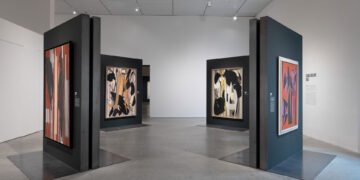








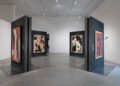
A landmark exhibition at the Metropolitan Museum of Art is rewriting the history of one of America’s most celebrated artistic partnerships. “Krasner and Pollock: Past Continuous” brings together more than 120 works by Lee Krasner (1908–84) and Jackson Pollock (1912–56). For the first time, the show treats both artists as genuine equals — a long-overdue reassessment of two figures whose legacies have never received the same level of attention.
Pollock has long dominated the conversation. A recent auction made him the newest member of the $100 million club. The 1991 Pulitzer Prize for Biography went to Jackson Pollock: An American Saga by Steven Naifeh and Gregory White Smith — a 934-page biography that later inspired the Hollywood film Pollock (2000). Marcia Gay Harden won Best Supporting Actress for her portrayal of Krasner in that film. Even in that context, Krasner played a supporting role.
Stay connected to every major update — subscribe and follow us on the PhoenixQ website and across our social media platforms.
That imbalance has persisted for decades. In 1981, curator Barbara Rose organized “Krasner/Pollock: A Working Relationship” to challenge the idea that Krasner was merely a second-tier artist and long-suffering wife. Rose argued their marriage was a partnership of equals. However, the effort fell short. Krasner remained in Pollock’s shadow.
An Exhibition That Finally Treats Them as Equals
The Met exhibition takes a bolder approach. It opens with archival footage and a panoramic view of the unheated, two-story shingled house and studio the couple shared on Long Island for nearly 11 years. Historic photographs show Krasner, Pollock, their dog Gyp, and their tamed crow, Caw Caw. That house is where Pollock created his most celebrated drip paintings — far from New York and his favorite haunt, the Cedar Bar.
Pollock developed his drip technique by unrolling unprimed canvas onto the studio floor and working horizontally. He applied enamel and house paints using sticks and brushes, never touching the canvas directly. His inspiration came from Janet Sobel (1893–1968), a self-taught Ukrainian-born artist. Her painting Milky Way (1945), which Pollock saw at Peggy Guggenheim’s Art of This Century gallery in 1946, directly influenced his first drip painting, Galaxy, completed in 1947.
Just two years later, LIFE magazine ran a headline asking: “Jackson Pollock: Is he the greatest living painter in the United States?” The article transformed him from a little-known abstract painter into an overnight celebrity. Four photographs showed him as a brooding, hyper-masculine figure in paint-splattered jeans. Krasner received no mention. The magazine portrayed him as a solitary male genius.
Krasner’s Emergence from the Shadow
The Met show directly challenges that myth. The first gallery presents Krasner’s collage works from the mid-1950s — a period when Pollock had reached an artistic impasse and was spiraling out of control. Previous exhibitions focused on Pollock’s decline. This one also highlights Krasner’s remarkable emergence during the same period.
Her 1955 work Bald Eagle demonstrates that emergence clearly. Krasner collaged scraps of dark brown linen and unprimed canvas that she and Pollock had discarded. A white shape at the center resembles a bird’s profile. Within it, Pollock’s dripped black line remains visible. By incorporating rejected material from both artists, Krasner created something entirely her own — a rebirth from destruction.
That theme runs throughout her career. Before she met Pollock, Krasner wrote lines from Arthur Rimbaud’s poem A Season in Hell on her studio wall: “To whom shall I hire myself out? What beast must I adore? What holy image is attacked? What hearts shall I break? What lie must I maintain? In what blood tread?” The words reflect how deeply she understood the difficulty of maintaining artistic integrity.
The curators also take a biographical approach in one gallery, placing early works by both artists side by side. The section opens with self-portraits — Krasner’s in graphite and crayon (ca. 1929–30) and Pollock’s in moody brown impasto (ca. 1930–33). Also on display are paintings from a 1942 group show, “American and French Painting,” curated by Russian émigré artist and theoretician John Graham. That exhibition placed Krasner and Pollock alongside Stuart Davis, Willem de Kooning, Picasso, and Henri Matisse. After seeing the show, Krasner sought out Pollock, not yet knowing who he was. The rest is history.
Major Works and a Long-Overdue Recognition
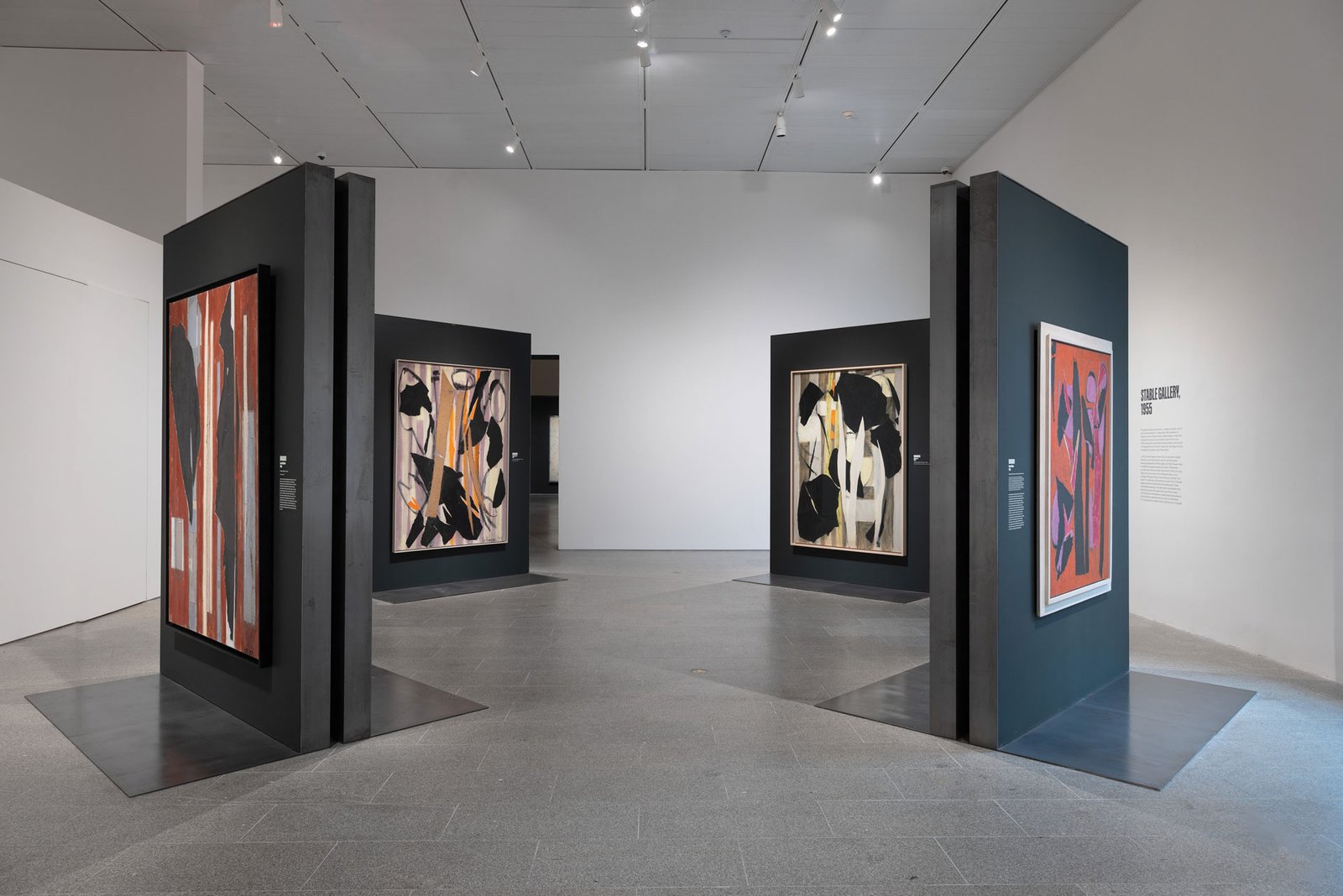
The exhibition includes several outstanding highlights. Pollock’s lyrical masterpiece Number 1, 1950 (Lavender Mist) features prominently. The show also recreates Krasner’s groundbreaking 1955 exhibition at the Stable Gallery. That show prompted critic Clement Greenberg to call her “a major addition to the American art scene of the era.” He later declared that Pollock’s drip paintings had moved beyond Cubism and produced the first great American paintings. While Greenberg acknowledged that Krasner had taken collage into new American territory, he stopped short of praising her as enthusiastically as he praised her husband. That double standard defined much of her career.
Her works Blue Level and Desert Moon (both 1955) show her at her most inventive. Both feature solid areas of color — blues and reds respectively — and construct a vertical world of raw, reaching forms. The verticality reads as an aspirational self-portrait. Destruction and rebirth merge, both literally and metaphorically.
The later rooms belong almost entirely to Krasner. Her The Seasons (1957) stretches nearly 17 feet and returns to the theme of rebirth just one year after Pollock’s death. The painting features abundant forms resembling genitalia — bold, unapologetic, and distinctly her own. That confidence continued through Past Continuous (1976), her final monumental collage, built from charcoal drawings she made while studying with Hans Hofmann.
Meanwhile, Pollock contributes a handful of singular late works, including Portrait and a Dream and The Deep (both 1953). His presence in the later rooms is smaller. Krasner’s is dominant — and rightly so.
The exhibition closes with Future Indicative (1977), a collage built from Krasner’s own figure drawings. Self-critical and never fully satisfied, she nonetheless produced multiple masterpieces in paint and collage that stand entirely on their own. “Krasner and Pollock: Past Continuous” at the Metropolitan Museum of Art finally gives Lee Krasner the recognition her powerful contribution to American art has always deserved.