English











































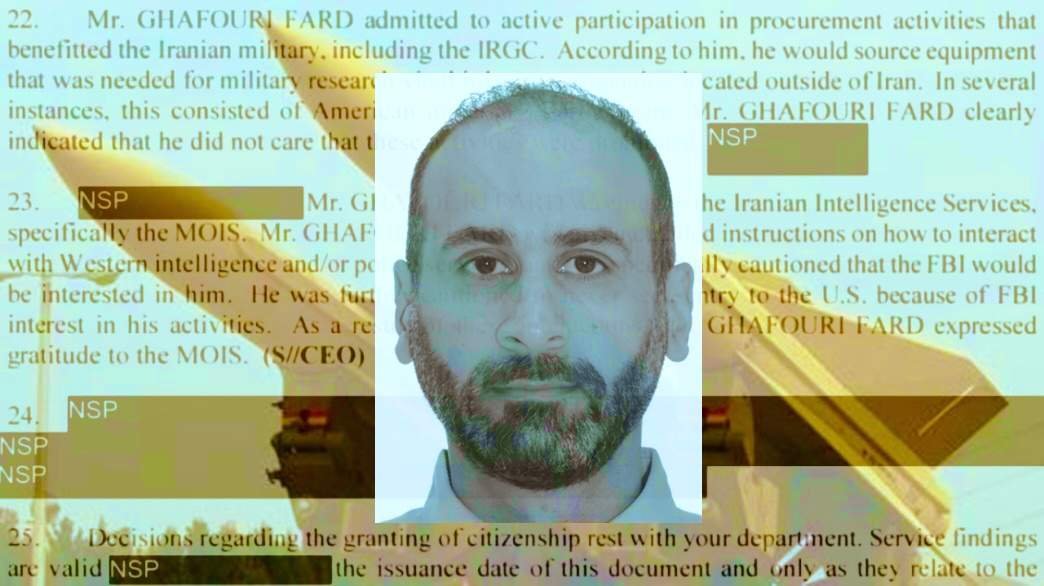
An Edmonton businessman who has received millions of dollars in Canadian government contracts is actually the son of a former Iranian vice-president and the subject of a long-running national security investigation, according to declassified intelligence documents. The man, known in business circles as “Sal Ghafouri,” is identified in a Canadian Security Intelligence Service report as Mohammad Reza Ghafouri Fard, an Iranian engineer who allegedly helped develop missile systems and electronic warfare tools for Iran’s military before immigrating to Canada.
Contracts Awarded Despite Security Flags
Since founding two Alberta-based companies, Ghafouri has collected more than $2 million in federal and provincial contracts. His clients have included the RCMP, the Department of National Defence and the Correctional Service of Canada. He also participated in an official Canadian trade mission to Latin America and received a federal business grant.
Stay connected to every major update — subscribe and follow us on the PhoenixQ website and across our social media platforms.
Canadian authorities first flagged Ghafouri for national security reasons in 2017. Despite this, his companies continued winning government procurement contracts for years afterward. In 2024, Innovation, Science and Economic Development Canada awarded his firm Melanite Group a $15,000 grant. Six months later, the Canadian Armed Forces awarded Melanite another contract.
University of Ottawa political science professor Thomas Juneau, who specializes in Iran and national security, reviewed the CSIS report and said the pattern pointed to a serious failure of coordination between government agencies. “I mean, it’s absurd,” Juneau said. “The system just goes to the other extreme.”
Alleged Role in Iranian Weapons Development
Before arriving in Canada as a permanent resident in 2013, Ghafouri allegedly spent years working as an engineer at an Iranian company called Rabi Kosar. CSIS says the firm conducted research and development exclusively for Iran’s military and sold its products to SA Iran, a satellite company of the Iranian Ministry of Defence, which then supplied them to the military and the Islamic Revolutionary Guard Corps.
According to the CSIS Security Screening Branch report, dated January 13, 2023, Ghafouri worked on three significant military projects during his time at Rabi Kosar. The first was the Shahin system, a medium-range anti-missile defence platform. Iran unveiled a domestically built air defence system in 2010, which it said used Shahin missiles with a range of 150 kilometres and surpassed the American-developed Hawk system it was modelled on.
His second project was RAAD, an electronic warfare system that used radio signals to jam enemy communications. The IRGC air force unveiled RAAD in 2012, describing it as designed to confront American aircraft at distances of up to 50 kilometres. His third project, SINA, was a direction-finding system capable of locating and tracking ships in the Persian Gulf.
Ghafouri also managed procurement for Rabi Kosar, coordinating with a Malaysia-based contact to source restricted components from third-party countries, including the United States. CSIS alleged this covert supply network existed because international sanctions blocked Iran from obtaining the materials directly. The agency noted that Ghafouri Fard “clearly indicated that he did not care that these activities were prohibited.”
Meetings with Iranian Intelligence
After moving to Alberta through Canada’s skilled worker program, Ghafouri returned to Iran in 2015 and met twice with members of Iran’s Ministry of Intelligence and Security. During the first meeting, he provided details of his employment in Canada. Agents asked whether he had travelled to the United States and whether he had contact with Canadian or American intelligence services.
At the second meeting, Iranian agents gave him detailed instructions about how to respond if police or intelligence services approached him in Canada. They advised him never to travel to the United States, warning that the FBI would take an interest in him because of his work at Rabi Kosar. The CSIS report noted that Ghafouri thanked the agents for the warning.
CSIS shared its security screening report with Immigration, Refugees and Citizenship Canada more than three years ago. In May 2026, the immigration department formally notified Ghafouri that it was launching proceedings to deny him citizenship on the grounds that he posed a threat to Canada’s national security.
Citizenship Battle and Legal Action
Ghafouri applied for Canadian citizenship four years after arriving in the country. The Canada Border Services Agency intelligence unit suspended his file within months, citing national security concerns. He subsequently sought help from his local Liberal MP, then from Ralph Goodale, who was then Minister of Public Safety. Both offices were repeatedly told that security checks were ongoing.
Ghafouri also wrote directly to the director of CSIS, claiming he had never been involved in any military or political matter in Canada or abroad. He threatened legal action and filed a complaint with the National Security and Intelligence Review Agency. The CBSA separately launched deportation proceedings against him based on his employment activities in Iran, but withdrew the case last November, citing an inability to use the required evidence.
Ghafouri is now suing the immigration department, arguing the delays have caused him hardship. He says he was unable to attend his father’s memorial service in 2023 because he lacked a Canadian passport. He has asked the court to award him between $5,000 and $25,000 in damages. His lawyer, Bjorna Shkurti, said her client strongly disputes the allegations and intends to pursue all available legal avenues. “He has lived in Canada for over a decade and has undergone multiple security screenings,” she said.
Iranian-Canadian human rights activist Kaveh Shahrooz, who also reviewed the CSIS report, said the case exposed a broader failure of due diligence. “Our politicians pay a lot of lip service to countering the Iranian regime’s nefarious influence in Canada,” Shahrooz said. “But cases like this show that we fail to conduct even the most basic due diligence on those with strong, direct ties to Iran’s regime.” CSIS, the immigration department and all federal agencies that awarded contracts to Ghafouri’s companies declined to comment.