English
























A new public exhibition space dedicated to contemporary Indigenous art has opened in Katonah, New York, bringing one of the world’s most significant collections of Native art to a Hudson Valley community for the first time. Branchline, located less than two blocks from the Katonah train station, serves as the public home of the Gochman Family Collection, which holds more than 850 works and has grown into a leading collection of contemporary Indigenous art in just five years.
A Collection Built for Access
Founder and custodian Becky Gochman has primarily kept the collection in her New York apartment, while around 200 works are on loan to institutions worldwide at any given time. The GFC has long welcomed museum groups, schools, and artists for private tours. However, the organization always aimed to make its holdings far more accessible to the public.
Stay connected to every major update — subscribe and follow us on the PhoenixQ website and across our social media platforms.
GFC creative director and curator Rachel Martin (Tlingít) spoke at a press preview on Thursday. She emphasized that stated values must be matched by real action. Martin described Branchline as a place for “bringing community together,” ensuring Native artists and the broader Katonah community both feel genuinely included in the space.
The name Branchline draws from a rail term meaning the point where paths diverge and new ones begin. GFC director Laura Phipps noted that the name also evokes the metaphor of trees, reflecting the organization’s intent to experiment and grow. Many visitors are expected to arrive by Metro-North train.
A Space Designed to Evolve
Branchline is free to the public and will eventually span 10,000 square feet across four buildings on an L-shaped plot. The current completed space includes a three-room ground-floor gallery, two upstairs rooms for visiting artists, and a ceramics studio. Future additions include a sculpture deck, a newly built barn for large-scale works, an experimental Annex, and a retail store and café called Twig.
The inaugural exhibition, “Line Break,” opens the nearly 2,000-square-foot gallery. Assistant curator Moonoka Begay (Ndee + Diné) and collection associate Nicole van Brugge organized the show. Rather than focusing on the formal qualities of lines, they treat the line as a metaphor for lineage, borders, cartographic marks, and sound barriers.
Twenty-Eight Works, Eighteen Artists
The exhibition features 28 works by 18 Indigenous artists across multiple generations and mediums. Jaune Quick-to-See Smith’s 1988 semi-abstract aerial view of the Flathead Indian Reservation hangs alongside Sara Flores’s 2024 geometric painting rooted in Shipibo-Conibo visual traditions. Teresa Baker’s fiber-based Echoes (2024) pairs with George Morrison’s acrylic landscape Night Shadows. Red Rock Variation: Lake Superior Landscape (1994).
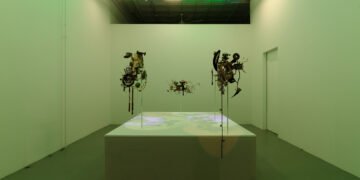
A centerpiece of the show is Raven Chacon’s Storm Pattern (2021–24), a handwoven wool textile paired with a multichannel sound piece. Chacon drew from sounds he recorded at the Oceti Sakowin camp at Standing Rock in 2016, where surveillance drones from police and counter-drones from protesters created an unexpected sonic overlap. He translated those flight patterns into a traditional Diné weaving structure.
Also on view are works by Nadia Myre, whose ceramic cylinder arrangements reference Northeast Woodlands wampum belt traditions, and Faye HeavyShield’s flexible strand of hand-strung red beads. The unfinished Annex currently houses drawings by Shuvinai Ashoona, who maps imagined scenes onto the Arctic landscape of Nunavut, Canada.
“What GFC is doing is not trying to become an institution,” Martin said. “It’s trying to just meet where things are needed, and a space is definitely needed for art that is outside of the white box that you’re used to seeing.”