English













































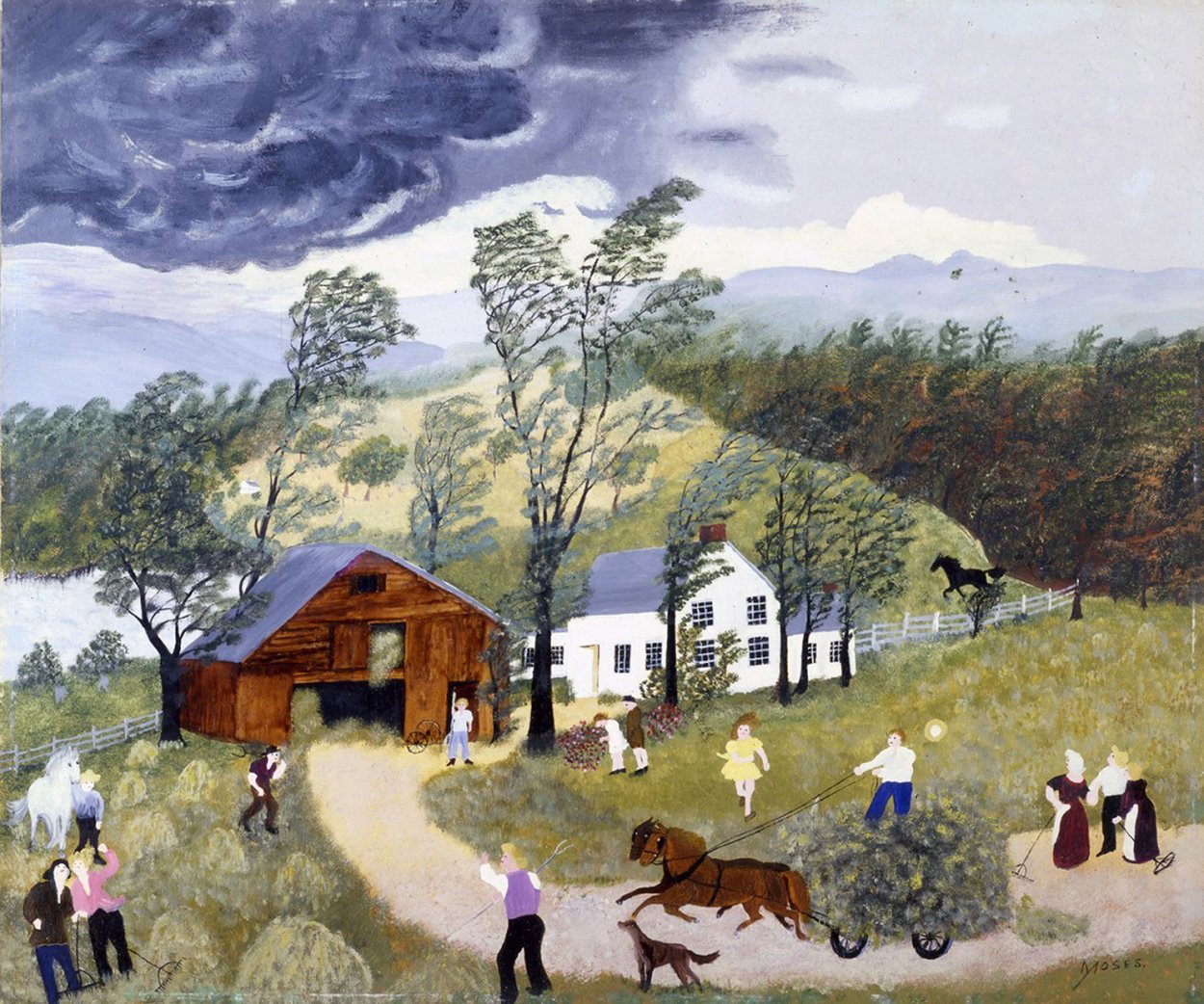
A major retrospective of Grandma Moses’s work at Crystal Bridges Museum of American Art in Arkansas presents a more complex portrait of the beloved painter than many visitors might expect. The exhibition challenges the familiar image of Moses as a cheerful folk artist and instead positions her within broader conversations about labor, aging, and American identity.
Fire, Detail, and an Unhurried Eye
The show opens with scenes of fire. A painting of a burning bridge in Troy blazes in red and orange, while Fire in the Woods (1940) fills the canvas with flames and smoke. This opening choice signals intensity rather than sentimentality, pushing back against assumptions about Moses’s relentless optimism.
Stay connected to every major update — subscribe and follow us on the PhoenixQ website and across our social media platforms.
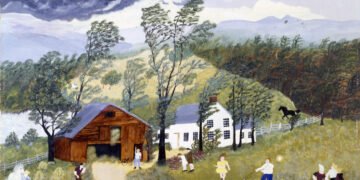
Despite a long and often painful life — Anna Mary Robertson Moses lost five of her ten children in infancy — she consistently chose joy as her subject. Most of the roughly 80 works on display depict scenes of work, celebration, and family life. Yet they carry a quiet heat. Moses channeled her energy into careful, repetitive marks: tidy haystacks, shaded leaves, and the checkered geometry of farm fields.
Cambridge Valley (1942) demonstrates her steady hand and patient eye. The painting captures an expansive New York landscape with remarkable topographic detail. People appear throughout her work, often adding gentle humor. In The Thunderstorm (1948), a man’s hat flies off in the wind, pressed flat against the picture plane in a perfect circle. Moses also applied glitter to her snow scenes, using the then-new material to make light radiate across the canvas — against the advice of her dealer.
A Lifetime of Making Art
Moses spent most of her life on farms in New York state and Virginia’s Shenandoah Valley. Those decades of rural experience gave her rich subject matter when she took up painting in her late 70s. However, the exhibition argues she had been making art throughout her life. A fireboard from 1918 was what she called her first large picture. Yarn works from the 1930s show her working confidently within a limited palette of solid colors.
These craft activities, often excluded from serious art spaces, gave Moses a way into visual storytelling. They also connected her to traditions of labor and making that would later define her painted world.
Modern Nostalgia and American Identity
Moses lived from 1860 to 1961, a span of 101 years that ran parallel with industrialization, two world wars, and the Cold War. Her painting style changed very little across her career. The exhibition catalog suggests this consistency reflected not ignorance of the modern world, but a deliberate engagement with it. Her work spoke to shifting ideas about the elderly, the growing representation of labor in 20th-century art, and Cold War efforts to project a vision of American goodness abroad.
Moses reportedly solved the compositional challenge of painting wide valleys by studying reflections in a car’s hubcap. Furthermore, she built a commercially successful brand through partnerships with companies including Hallmark. She appeared on talk shows and in documentaries, skillfully using the image of a modest farmwife to disarm critics. In the end, her art offered something the postwar era seemed to crave: a sense of lost authenticity. As the exhibition makes clear, there is nothing more modern than that.