English



































China has firmly rejected international calls to slow the development of artificial intelligence, dismissing warnings from prominent U.S. technology leaders as politically motivated fearmongering rather than genuine safety concerns. Beijing’s pushback marks a significant escalation in the growing divide between the world’s two largest economies over the future of AI development and governance.
Chinese Foreign Ministry spokesperson Guo Jiakun addressed the issue at a regular press briefing on Monday. “Fearmongering, confrontation and malicious competition will only disrupt the process of global AI governance and serve no one’s interests,” he told reporters. The state-run Global Times newspaper took an even sharper tone on Sunday, describing the calls for an industry slowdown as a “Cold War playbook” targeting China’s technological progress.
Stay connected to every major update — subscribe and follow us on the PhoenixQ website and across our social media platforms.
Amodei’s Essay Sparks International Debate
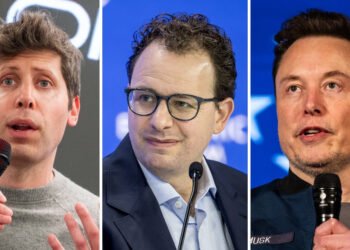
The controversy began after Anthropic CEO Dario Amodei published a lengthy essay on Saturday titled “We Must Pace The Frontier.” In it, he argued that AI companies should deliberately slow the pace at which they improve their models, citing serious potential risks. He also warned that a Chinese lead in AI “would pose grave danger for the United States and the world” and called on the U.S. government to restrict sales of key technology to China.
OpenAI CEO Sam Altman endorsed the essay and later posted on X that governments would need to support international coordination on AI. SpaceX founder Elon Musk also backed the message. Altman additionally said his company would adopt at least one of the safeguards Amodei proposed.
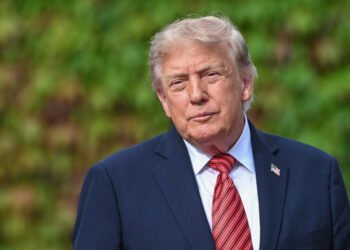
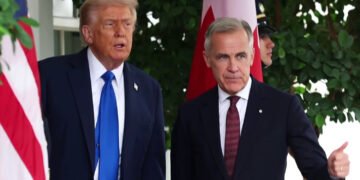
However, President Donald Trump rejected the safety warnings entirely. “We’re leading China in AI. We’re the most sophisticated country in the world, and frankly I want to keep it that way because whoever wins AI wins,” Trump told reporters on Sunday. He criticized what he called “very negative forces” for raising concerns about risks he described as unlikely to materialize.
Beijing Acknowledges Risks but Rejects Outside Pressure
Despite rejecting foreign calls for restraint, China has not entirely dismissed AI safety as a concern. State Security Minister Chen Yixin wrote in the state-run China Cyberspace magazine on Sunday that China must “accelerate the establishment of a system for preventing and controlling AI security risks.” He also called for broad international cooperation, describing AI as “a new track for strategic rivalry.”
Meanwhile, Chinese companies have rapidly advanced their AI capabilities. They now offer high-performance models at a fraction of the cost of leading U.S. systems. President Xi Jinping has positioned China as a champion of open-source AI development. At the BRICS summit in India on Sunday, Xi offered member nations assistance in developing open-source AI tools. He has also outlined a potential AI governance framework aimed at Global South countries.
The dispute over AI development comes alongside a separate accusation from U.S. agencies. Earlier, those agencies published an alert claiming that top Chinese AI companies had systematically copied cutting-edge American AI models through a process known as distillation. Beijing rejected the accusation outright.
Experts Warn of Deep Mutual Suspicion
Analysts say the gap between Washington and Beijing on AI reflects a broader breakdown in trust. Ja Ian Chong, an associate professor of political science at the National University of Singapore and a nonresident scholar at Carnegie China, told NBC News that China has little interest in following rules written by others.
“They want to write the rules. I don’t think they want to follow anybody else’s,” Chong said. He added that while both sides talk about cooperation, their behavior tells a different story. “There’s the sort of talk of cooperation, but the behavior suggests otherwise, and underlying that behavior, I think, is this deep mutual suspicion,” he said.
Amodei himself compared the situation to the Cold War arms race. Speaking on CBS’s Sunday Morning, he said the two sides should work together but admitted he held little hope for meaningful collaboration. Chong echoed that view. “It’s a bit like an arms race. And to get de-escalation there needs to be simultaneous neutral self-restraint, and it’s difficult to see how that would come about in this kind of environment,” he said.
Nevertheless, some observers see a narrow path forward. Theo Bertram, director of the London-based Social Market Foundation, suggested that even without a bilateral agreement, both countries could independently pursue stronger domestic AI regulations. “The idea that we could see the domestic introduction of some safeguards in both countries is not impossible,” Bertram said. He added that domestic accountability measures could help manage what he described as an “inevitably growing political and public demand globally” for AI oversight.
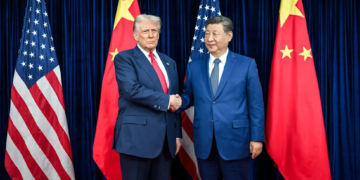
The AI rivalry between the U.S. and China is expected to feature prominently when President Xi Jinping and President Trump meet in Washington on September 24.