English






























Art Basel Paris 2024 brought together roughly 200 booths at the Grand Palais, offering an impressive but sometimes overwhelming range of work. As the fair grows in stature, galleries increasingly arrive with major, high-value pieces. Six-, seven-, and even eight-figure works now dominate much of the floor. During the Avant-Première VVIP preview on Tuesday afternoon, galleries reported strong early sales, with more deals expected through Wednesday’s close.
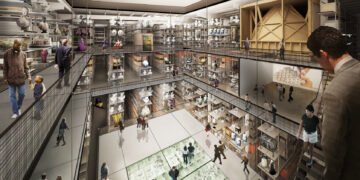
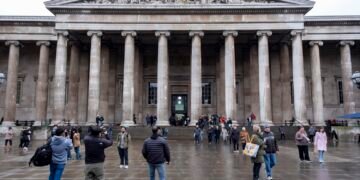
While the ground floor leans heavily toward established market favorites, the upper level rewards those willing to explore. Some of the most compelling work at this year’s fair sits upstairs, away from the blue-chip axis below. And even when nothing on the walls demands attention, the Grand Palais itself delivers. Its green-painted steel-and-glass ceiling alone is worth the visit.
Stay connected to every major update — subscribe and follow us on the PhoenixQ website and across our social media platforms.
The fair runs through October 25. Here is a look at the standout booths from Art Basel Paris 2024.
Highlights From the Main Floor
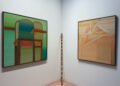
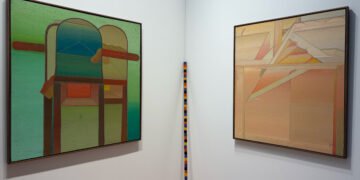
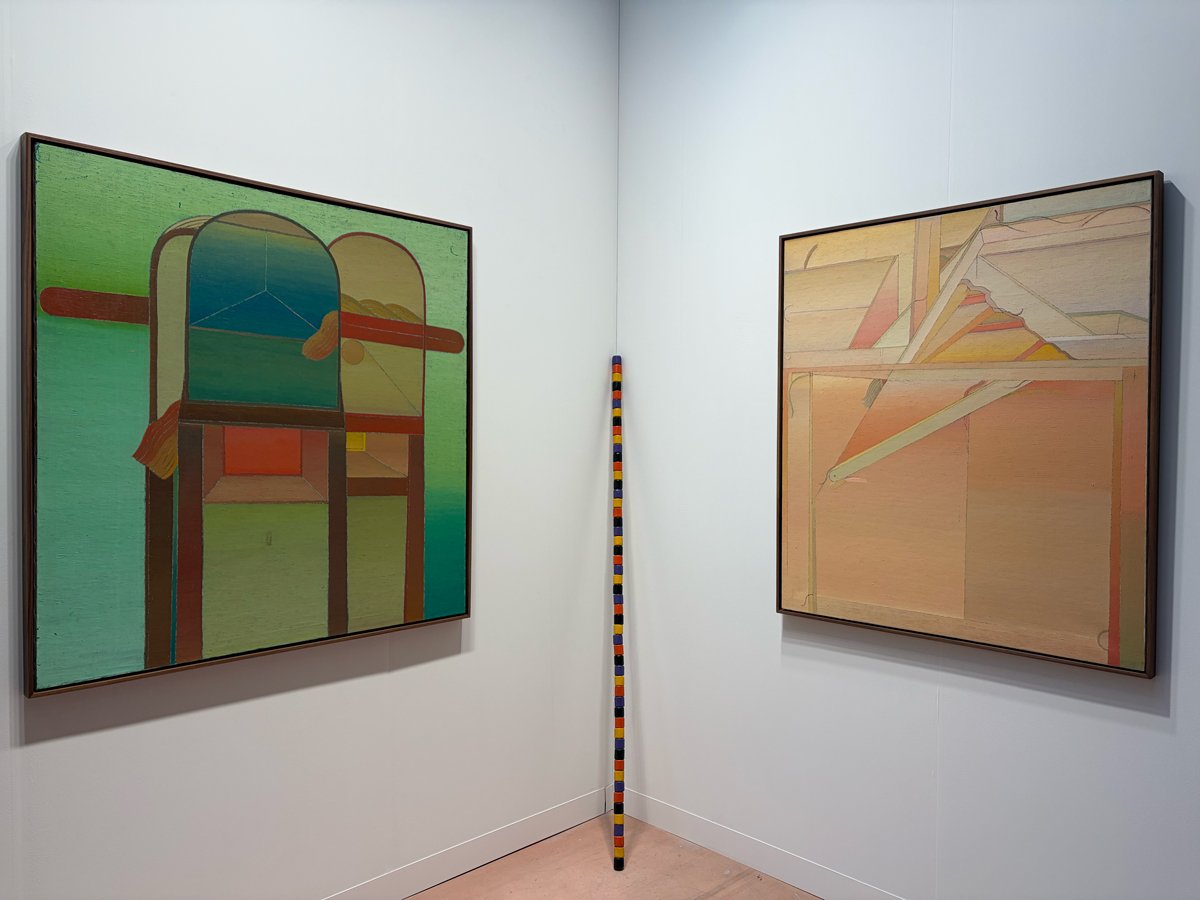
New York’s Ortuzar gallery presents two striking abstract paintings by Miyoko Ito, both from the mid-1970s. Ito had loose ties to the Chicago Imagists. Her reputation has grown considerably over the past decade, partly driven by a 2017 survey at the Berkeley Art Museum and Pacific Film Archive. Ito studied at the University of California, Berkeley, in the 1940s. The university awarded her a diploma while she was held at the Topaz internment camp during World War II. Her works at Ortuzar showcase a masterful use of geometry. She applied thin, dry layers of paint to create remarkable color gradients.
Nearby, Xavier Hufkens presents a bench-like sculpture by Tatiana Trouvé. The piece is part of her ongoing “Guardian” series, centered on an unseen figure who also appears in her site-specific commission at the Upstate New York property of collectors Jill and Peter Kraus. Trouvé built the sculpture from fragments of past works and studio materials, including Styrofoam and blankets, then cast everything in aluminum and painted it by hand. Trouvé is also currently the subject of a solo show at the Brussels gallery.
In the fair’s secondary market section, Helen Frankenthaler’s Ivory Rose (1987) stands out as the most memorable work. Yares Art is asking $1.6 million for the piece. Frankenthaler applied her signature canvas-staining technique to create a purplish ground, then layered thick brushstrokes of magenta, red-orange circles, a vertical streak of slime green, and white sprinkles on top. The contrast between the stained base and the applied paint is remarkable.
Discoveries Upstairs
Istanbul gallery The Pill brings two works by Cem Örgen, who will have a solo show at the New Museum early next year. Örgen studied industrial design at Bilgi University in Istanbul. His work at Art Basel Paris uses that training as a starting point, then subverts it to explore bodily fragility. Horses (2024) is a steel chair that cannot support a seated person. Its name comes from a small illustration on the Faber-Castell pencil logo, showing two mounted warriors in battle. Open Surgery (2024) uses Alucobond, a building insulation and fire-retardant material, shaped to mimic electrical wiring. Örgen added two medical silicone suture pads to the surface. Together, the works use tactility as a metaphor for vulnerability in today’s hyper-connected, media-saturated world.
Carl-Edouard Keïta, showing with Cecile Fakhoury, focuses his latest body of work on the post-independence period of his native Côte d’Ivoire. “It was a hopeful time,” he told ARTnews on Wednesday morning. Using a Cubist-influenced geometry, Keïta renders scenes from sporting events and dance clubs to critique the present through the lens of the past. His painting Les muses de l’Hôtel Ivoire features two elegantly dressed Black women in 1970s clothing alongside a traditional African sculpture. Keïta first encountered that sculpture at the Salon Art + Design fair in New York and later discovered it originated in Côte d’Ivoire. His research also brought him to the Metropolitan Museum of Art’s Costume Institute, where he found a Karl Lagerfeld dress designed for Chloé in 1970, titled Côte d’Ivoire, originally made for a Texas socialite. He placed that dress on one of the women in the painting. The other woman wears a dress of his own design, imagining how an Ivorian woman of that era might have dressed herself.
Shared Booths and Emerging Voices
Art Basel Paris 2024 features a record 12 booths shared between two galleries. Among the best is the joint presentation by Chapter NY and London’s Soft Opening. Both galleries represent London-based artists whose practices deal with memory, though in very different ways. Mary Stevenson’s Surrealist-inflected paintings explore psychological spaces. Her work Red Chairs shows five chairs floating in an almost star-like arrangement. The number five reflects her place among five siblings and the way their relationships orbit one another. She builds these ethereal images using thin layers of paint on rabbit-skin-glue-primed linen. In contrast, Ebun Sodipo works with found images drawn from art history, film, and social media. She mounts these onto Mylar and seals them under two layers of resin. Through this process, Sodipo proposes new futures for Black trans people by revisiting collective memory.
Montreal’s Eli Kerr made history as the first Canadian gallery to participate in Art Basel Paris. Kerr chose the Emergence section, which occupies the balconies above the main floor. Working with Berlin-based artist duo Rosario Aninat and Simon Shim-Sutcliffe, Kerr built a sleek black-painted bleacher structure inspired by a ziggurat. Around 15 abstract sculptures sit on the structure, each pairing contrasting materials: cast tin with cast copper, padauk wood with epoxy clay, hand-blown glass with newsprint, and Nero Assoluto granite with Belgian bluestone and vulcanized rubber. A recent research trip to China, where the duo encountered Neolithic objects, inspired the works. Each piece functions as a kind of funerary object, aiming to bridge heaven and earth through its mix of materials. Every sculpture also comes with a 35mm black-and-white photograph, not displayed at the fair, which serves as its certificate of authenticity.
Standouts in the Premise Section
Tucked into a corner of the ground floor, the Premise section hosts what the fair describes as highly singular curatorial proposals. London’s Amanda Wilkinson Gallery delivers the section’s strongest presentation with a focused booth of Derek Jarman’s “Tar Paintings,” made between 1989 and 1991. Carl Jung’s Psychology and Alchemy influenced Jarman’s approach. He applied tar to a wide range of found materials, transforming them through an almost alchemical process. He created the series while also working on his film The Garden (1990), which includes a scene depicting someone being tarred and feathered. In that context, the paintings become a pointed commentary on the treatment of HIV-positive people during the AIDS crisis. The most affecting work on view is Clothes (1989), which incorporates the blue overalls Jarman wore while gardening, several found photographs, a set of old metal keys, and other objects, all covered in tar and scattered with feathers.
Also worth noting is Meriem Bennani’s sculpture A Knife, on view at Lodovico Corsini. The work is more minimal than much of her previous output. A simple machine moves a suspended knife up and down in a slow, menacing rhythm. The wooden armature beneath the blade shows marks where the knife has already landed. A rod holding strands of blonde hair, resembling a feather duster, contrasts with the sharpness of the blade. As with much of Bennani’s work, dark humor and genuine unease exist side by side.