English



































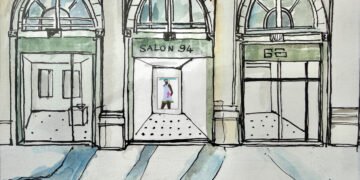
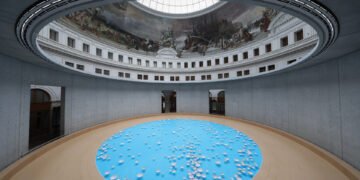









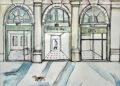
Ghanaian artist Ibrahim Mahama is preparing to open what he calls the most ambitious exhibition of his career. Starting next week, he will take over the entire building of the Fondation Cartier pour l’art contemporain in Paris for a major show titled “The Harvest Season.” The exhibition draws directly from his community-rooted practice in Ghana and reflects decades of collaborative work across art, history, and cultural infrastructure.
A Career Built on Community
Mahama consistently credits his success to the people around him. His community includes market women, weavers, craftsmen, railway workers, studio assistants, curators, professors, and fellow artists. “We live and work in a community and nobody is an island by themselves,” he told ARTnews. “I built my practice based on the idea of collectivity and working with different collaborators.”
Stay connected to every major update — subscribe and follow us on the PhoenixQ website and across our social media platforms.
That philosophy dates back to the earliest days of his career. While still a college student, he began collecting worn-out jute sacks from women at Mallam Atta market in Accra. At first, they met him with suspicion. Over time, however, they came to understand his work and continued supporting him. Those sacks became central to his art, and works made from them appeared memorably in Okwui Enwezor’s Venice Biennale in 2015.
In recent years, Mahama has received significant international recognition. In 2025, ArtReview ranked him at the top of its influential Power 100 list. He also won an Art Basel Gold Award that year and later received the 2026 Arnold Bode prize. Furthermore, the French government named him a chevalier of the Ordre des Arts et des Lettres. France’s Ambassador to Ghana, Diarra Dime Labille, presented the honor to him in Ghana.
Reinvesting Success Back into Ghana
Despite his global profile, Mahama directs the proceeds of his work back into Ghana. Sales fund institutions he has founded, including the Red Clay Studio and the Savannah Centre for Contemporary Art, both based in Tamale. He has also purchased abandoned buildings, factories, and airplanes and converted them into art and educational spaces, as he did with Nkrumah Voli-ni, also in Tamale.
He describes these projects as a “lifetime work.” They restore collected materials, industrial heritage, and national archives. His collaborative reach also extends beyond Ghana. He has worked with Kenyan-British artist Michael Armitage and his Nairobi Contemporary Art Institute, expanding the scope of what his practice can achieve.
Exhibition curator Aby Gaye-Duparc explained that Mahama’s practice has two distinct dimensions. “There’s work that we see: installations, videos, work on paper,” she said. “Everything comes from this community in Tamale that he has built, because a lot of the installations were made first in Tamale and then travel to Paris or other venues.” The second dimension, she added, is the artistic infrastructure he continues to build in northern Ghana, which has expanded access to the arts for many people previously excluded from it.
What the Paris Exhibition Contains
The Fondation Cartier show brings together several major works. Parliament of Ghosts, an ongoing installation that first premiered in 2019, returns in a new iteration. It incorporates discarded train seats, railway sleepers, school furniture, worn-out jute sacks, and government archives. For this exhibition, Mahama has added approximately 200 collected and restored royal stools from the Asante Empire.
The inclusion of those stools carries a deliberate message. Mahama noted that similar stools are often looted and then displayed behind glass in Western museums. At the Fondation Cartier, visitors will have free and direct access to them. He hopes this raises new questions about the return of African objects from Europe. “What happens when these stools are brought from Ghana to Europe as living objects and utilized for their original purpose?” he asked. Doing so, he said, brings out “the ghosts and histories” of the objects and opens new conversations.
A second major new work, titled Things Fall Apart, centers on the Aboso Glass Factory. Ghana’s first president, Kwame Nkrumah, established the factory in 1966 as part of the country’s industrialization drive. However, a coup that same year cut the project short. Mahama purchased the abandoned glass bottle manufacturing plant roughly two years ago, using production funds from the Fondation Cartier. The title comes from the 1958 novel by Nigerian author Chinua Achebe.
The Paris installation represents only a portion of the broader project. The factory is also being rebuilt at Red Clay Studio in Tamale and at a British-era colonial building. After the Fondation Cartier exhibition closes, the factory will return to Ghana for permanent installation in Kumasi, where Mahama plans to establish a new institution. He is also exploring the possibility of rebuilding abandoned cinemas across the country, working alongside cinema owners and local craftsmen.
In addition, the exhibition features a collection of works focused on Ghana’s railway system. A new textile installation, made from Ghanaian fabrics produced in northern Ghana, truck inner tubes, jute sacks, and found textiles, will hang across the arcades on the building’s façades. Gaye-Duparc noted the connection between the building itself and Mahama’s themes. “There is a dialogue between this old building, constructed in the 1850s, and Ibrahim’s work, which addresses the history of the 19th century in Ghana and the links between what was happening between Europe and West Africa at that time,” she said.
In line with his collaborative approach, the exhibition also features work by other artists and collectives. These include James Barnor, Gideon Appah, CATPC, Tjaša Rener, Postbox Ghana, Courage Dzidula Kpodo, and Dorothy Akpene Amenuke, who is Mahama’s mentor. Kpodo, an architect, will present work that challenges the dominance of tropical modernism in Ghanaian cities. His central piece reconstructs a wall using laterite from a building he owns in Gyampo, in the Eastern Region. The installation also includes around 100 postcards from the Postbox Ghana collective depicting modernist buildings in Accra, Kumasi, and Takoradi. “I would describe Ibrahim as someone who makes space within his own abilities and means for people that he thinks are doing interesting, important work,” Kpodo said.
Police Attack and Ongoing Investigations
The Fondation Cartier exhibition is among the first major shows Mahama has staged since a serious incident earlier this year. A special operations unit of the Ghana Police Service attacked him in Tamale, where he lives and works. The attack drew widespread condemnation.
Mahama said the community response overwhelmed him. “It was fantastic, I must say. I was really overwhelmed, because sometimes you don’t realize how much your work means to people,” he said. People traveled from Tamale and from cities including Accra and Kumasi to visit him and express their concern. He added that many mourned the treatment he received, particularly given his contributions to the city.
Ghana’s Inspector General of Police directed the Criminal Investigation Department to look into the matter. However, Mahama said he had not received any updates in months and remained unaware of the current state of those investigations. He plans to follow up when he returns to Ghana by the end of the year. Meanwhile, he said he remains disappointed in how the police handled the situation. “I hope that at some point, we will be able to at least know more, so that we see what direction to take it in,” he said.
For now, Mahama is focused on his work and the community he has helped build. “I’m happy that the work I do has a very profound meaning and effect on people who live on our continent, in particular Ghana,” he said. “I am also interested in how this work is traveling around the world, stretching the African sensibilities, and what we are bringing to art in the 21st century.”