English








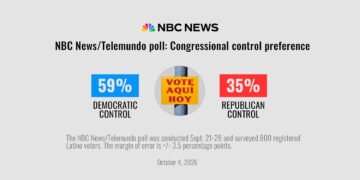




































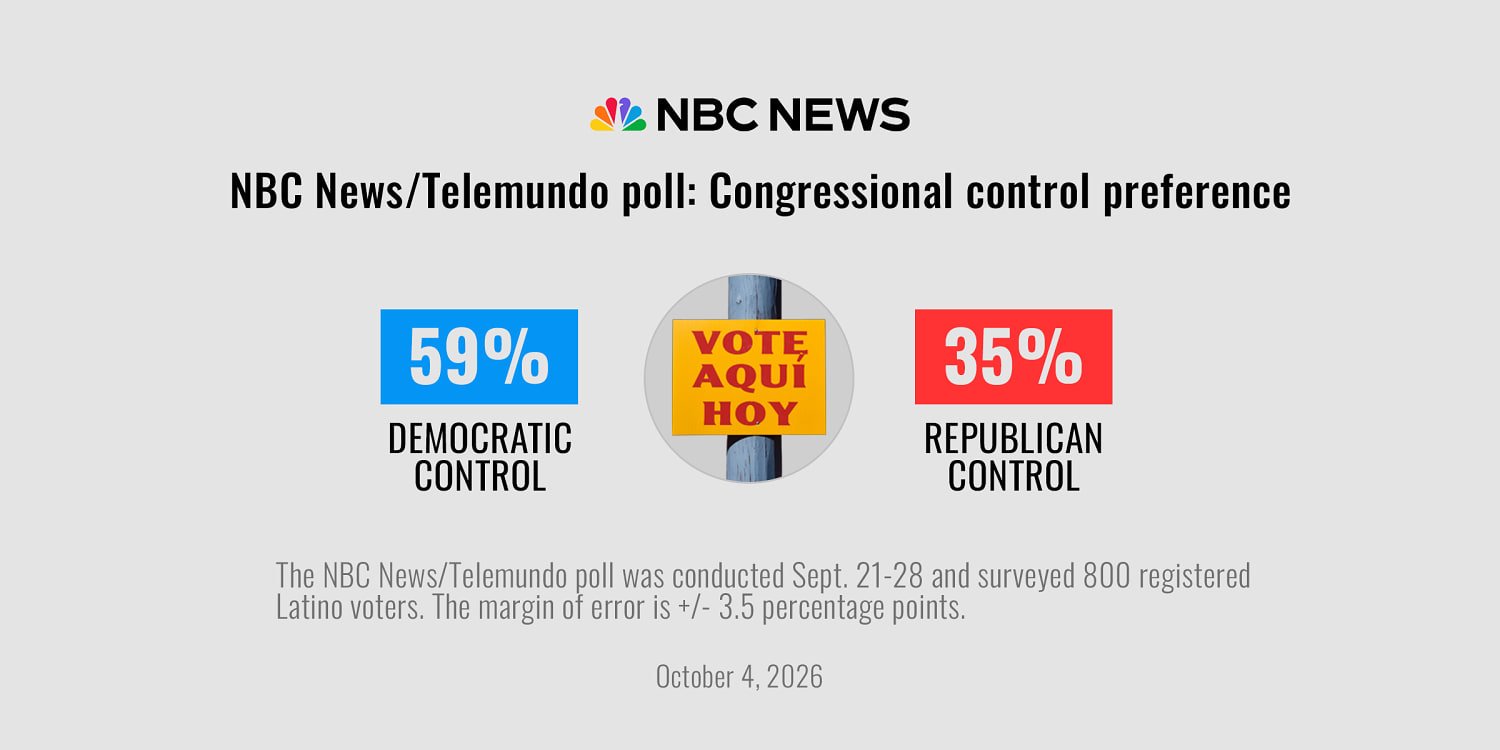
Latino voters are turning away from Donald Trump and the Republican Party at a significant rate, according to a new NBC News/Telemundo poll. The survey shows Democrats now hold a 24-point lead among Latino voters on the question of which party should control Congress. That figure is double the Democratic margin recorded among this group at the same point in 2024.
The poll surveyed 800 registered Latino voters between September 21 and 28, using a mix of telephone interviews and text-based online surveys. Twenty percent of interviews took place in Spanish. The margin of error is plus or minus 3.5 percentage points.
Stay connected to every major update — subscribe and follow us on the PhoenixQ website and across our social media platforms.
Sharp Reversal on Key Issues
The shift in Latino voter sentiment has been dramatic. Two years ago, Latino voters gave Trump a four-point edge over then-Vice President Kamala Harris on handling the economy. Today, those same voters give Democrats a 21-point advantage on the same question.
Latino voters now disapprove of Trump’s handling of the cost of living (78%), the economy (74%), immigration (69%) and foreign policy (68%). His strongest result among the five issues tested is border security, where 39% approve and 58% disapprove.
For comparison, in September 2022, 60% of Latino voters disapproved of President Joe Biden’s handling of the cost of living, and 54% disapproved of his economic management. Trump’s current numbers fall well below those figures.
Nearly two-thirds of Latino voters — 65% — say Trump’s policies have hurt economic conditions. Among Latino independents, that figure rises to 72%. Only 10% of Latino independents believe his policies have helped the economy.
Inflation and the cost of living ranked as the top concern for 33% of Latino voters in the poll. A majority, 52%, placed it among their top two most important issues. Latino voters who prioritize the cost of living now prefer a Democratic-controlled Congress by 22 points. In 2024, Republicans held a four-point edge among that same group.
Immigration Enforcement Draws Widespread Criticism
While immigration ranked lower than economic concerns on the priority list, Trump’s deportation policies drew strong opposition. Two-thirds of Latino voters say his immigration enforcement measures have gone too far. Only 22% say he has struck the right approach, and 9% say he has not gone far enough.
There is a clear distinction in how Latino voters view different enforcement approaches. While 83% support deporting undocumented immigrants who have committed serious crimes, only 37% support deporting every undocumented immigrant in the country.
Republican pollster Micah Roberts, who co-conducted the poll with Democratic pollster Aileen Cardona-Arroyo of Hart Research Associates, acknowledged the gap. “There is support for a certain level of immigration enforcement, but the Latino electorate believes it’s gone way too far,” he said.
The poll also found that 31% of Latino voters say they or someone close to them has started carrying identification because of concerns about ICE enforcement. Meanwhile, 27% say they know someone who has been deported or detained by ICE in the past two years. In addition, 17% say they or someone close to them has considered not voting in person this year due to ICE-related concerns.
Voters Share Personal Stories of Disappointment
Several poll participants spoke to NBC News in follow-up interviews about their changing views.
Luisa Santiago, a 59-year-old retiree from Florida, voted for Trump in 2024 after a lifetime of supporting Democrats. She also persuaded many of her friends to do the same. She now calls that decision “a complete mistake” and describes Trump as a “disappointment.”
“I’m more embarrassed than my friends because I was the one who convinced them to vote for him,” Santiago said. She described Trump’s deportation policies as “brutal” and “cold,” and said the difficult economic climate is weighing heavily on her family.
A Florida voter in her 20s, who gave only her first name, Maria, also voted for Trump in 2024. She told NBC News he has “fallen short.” She said she has seen friends and family members deported despite having legal paperwork. “They were supposed to be here. They had paperwork, and it didn’t matter. And now they can never come back,” she said. She added that one friend’s grandfather was deported to Mexico rather than to his home country of Cuba.
Midterm Implications and Democratic Caution
The poll results carry significant implications for the 2026 midterm elections. Republicans had made Trump’s 2024 gains among Latino voters a central part of their strategy to hold the House majority. In Florida and Texas, the party drew new, heavily Latino districts based on those results. However, many of those districts now look competitive as Latino voter preferences shift.
Roberts described Latino voters as “the swingiest of swing groups” and called the reversal since 2024 “stunning.” He said the data suggests 2024 was an outlier. “Trump is a central figure. He’s had real consequences on our politics, and without his presence, I think none of these changes would be evident in the data among Latinos,” he said.
Latino voter enthusiasm is also rising. A sizable majority, 72%, rate themselves a 10 out of 10 in interest in the November elections, compared with 54% at this point in 2024. Furthermore, 54% say their midterm vote is meant to signal opposition to Trump, while 21% say they want to signal support for him.
However, the results are not entirely positive for Democrats. Negative views of the Republican Party among Latino voters have jumped 16 points since 2024, reaching 62%. By contrast, negative views of the Democratic Party have also edged up by four points, now sitting at 42%. Democrats have not improved their image over the past two years.
Cardona-Arroyo noted that Democrats still have work to do beyond the midterms. “What do Democrats do to move beyond this place where they’re running on opposition to the Republican Party, which I think will work in ’26?” she said. “It’s sort of an open question of whether that will work in ’28.”
The poll also found that socialism remains unpopular among Latino voters. Only 13% view it positively, while 41% view it negatively and 38% feel neutral about it. Despite her reservations about the Democratic Party, Maria said she is leaning toward voting Democratic. “I feel like I have to put my faith in them now to fix things,” she said.