English









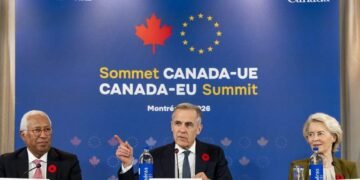



























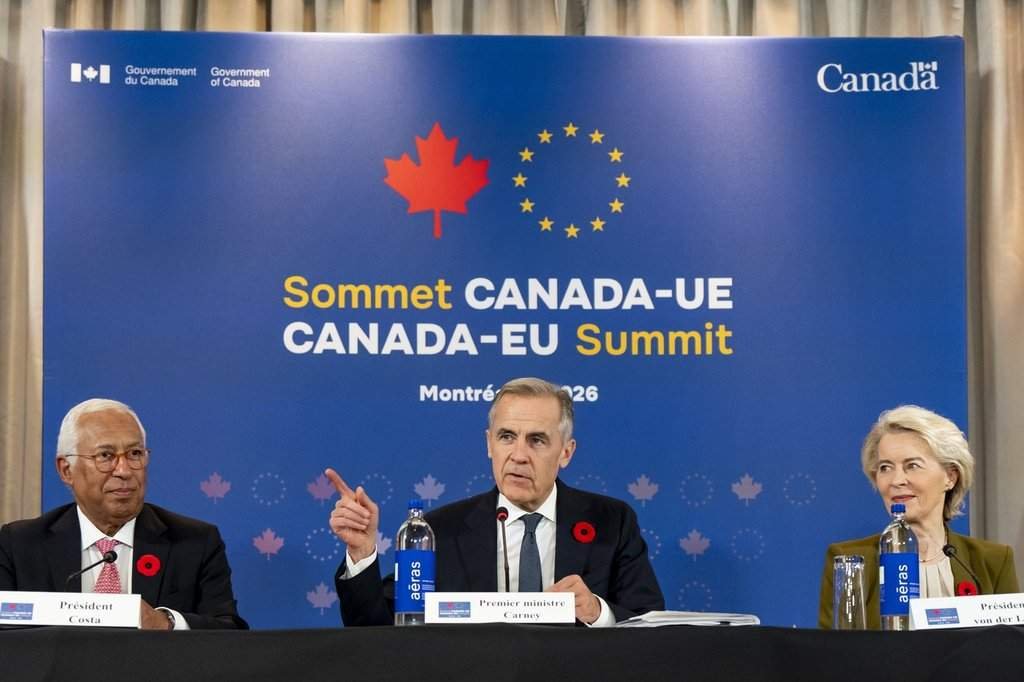
Canadian Prime Minister Mark Carney wrapped up a high-profile Canada-EU summit in Montreal on Friday, with leaders announcing progress on digital trade and new agreements on academic and scientific exchanges. The summit brought together European Commission President Ursula von der Leyen and European Council President António Costa, who joined Carney in Montreal on Thursday.
Digital Trade and Academic Partnerships Take Centre Stage
Costa confirmed that a digital trade agreement was expected to be finalized by the close of the summit. In addition, leaders announced plans for scientific research partnerships and university student exchange programs. Costa also expressed a desire to expand labour mobility between Canada and Europe, alongside easier pathways for student movement between the two regions.
Stay connected to every major update — subscribe and follow us on the PhoenixQ website and across our social media platforms.
While Canada and the EU have held similar summits for years, both sides described this gathering as a meaningful step toward deepening their commercial and diplomatic ties. The scope of discussions went well beyond trade, touching on cultural policy, content regulation and workforce mobility.
Culture Minister Raises Film and Streaming Issues
Canadian Culture Minister Marc Miller met with his European counterparts during the summit to discuss content regulation on streaming platforms. He focused on how Canada and Europe could align their approaches to promoting domestic content and protecting children online.
“We’re not talking about the same exact rules potentially, but convergence and allyship with respect to large transnational companies that in some cases need to be regulated to protect kids or to promote our cultures,” Miller said in an interview.
Miller noted that labour mobility in film and television production would require involvement from Canada’s provinces. Many provinces operate their own tax credit programs that support local talent, making federal agreements more complex. However, he said both sides are exploring ways to expand co-productions, pointing to the TV series Vikings as a successful example of a Canadian-Irish joint project.
Canada already holds co-production treaties with several European countries. These treaties allow filmmakers to pool tax credits and attract major productions. Miller also brought EU counterparts to a promotional event for Villeneuve: The Rise of a Legend, a documentary on Quebec Formula One driver Gilles Villeneuve that premiered at the Toronto International Film Festival. He said part of that visit aimed to secure a theatrical release for the film in Europe.
Associate Membership Proposal and Political Criticism
Carney, Von der Leyen and Costa all expressed support for Canada becoming an “associate member” of the European Union. However, the proposal has not gained universal backing. Countries such as Germany have rejected that specific term, and Canadian officials have also been cautious about using the phrase publicly.
Meanwhile, Canada’s Conservative opposition criticized the summit. They pointed out that nine of the EU’s 28 member countries have still not ratified a trade deal with Canada that is now a decade old. Critics argued the summit highlighted ongoing gaps in the Canada-EU relationship rather than resolving them.
Despite the political pushback, leaders presented the Montreal summit as a forward-looking moment. Both sides signalled a shared interest in stronger ties on trade, culture and research in the months ahead.