English








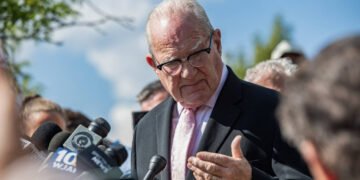



















The U.S. Supreme Court has blocked Missouri’s newly drawn Republican congressional map from being used in this year’s elections. The court issued a brief emergency order on Thursday, with no noted dissents, granting a request from a group called People Not Politicians, led by activist Richard von Glahn.
The ruling puts on hold a decision by U.S. District Judge Stephen Clark, a Missouri-based federal judge who ruled on Tuesday that the new map must be used. That ruling directly contradicted an earlier decision by the Missouri Supreme Court, which had reached the opposite conclusion.
Stay connected to every major update — subscribe and follow us on the PhoenixQ website and across our social media platforms.
Missouri Likely to Return to 2022 Congressional Map
The Supreme Court’s order effectively signals the end of the dispute over which map Missouri will use in the November midterm elections. The state will most likely revert to its previous 2022 congressional map. That map includes six seats held by Republicans and two held by Democrats.
The new GOP-drawn map sought to eliminate one of those two Democratic seats. That seat currently belongs to Representative Emanuel Cleaver, a Missouri Democrat.
Von Glahn welcomed the decision. “The law is the law, the Missouri constitution is clear, as was the Missouri Supreme Court,” he said in a statement. He also criticized Missouri Secretary of State Denny Hoskins, a Republican who led the push to implement the new map. Von Glahn said Hoskins “has shown that he cannot effectively do the job he was elected to do.”
Both Sides Made Last-Minute Arguments
Before the Supreme Court issued its order, Hoskins’ lawyers filed an urgent brief arguing that only Judge Clark’s ruling could prevent the “disenfranchisement of hundreds of thousands of voters” who already cast ballots in the primary using the new map. They also argued it was the only way Missouri could “conduct congressional elections that comply with the federal election calendar.”
The Trump administration also filed a brief in support of Hoskins. It warned that blocking Clark’s ruling would “jeopardize state officials’ ability to conduct a timely and lawful federal election.”
However, the Supreme Court sided with People Not Politicians. This also marks the second time the dispute has reached the nation’s highest court. Earlier on Tuesday, Justice Brett Kavanaugh had already rejected a separate request from Hoskins to block the Missouri Supreme Court’s ruling.
Contempt Hearing Adds to Legal Pressure on Hoskins
Meanwhile, the Missouri Supreme Court held a hearing on Thursday morning to consider whether to hold Hoskins in contempt for defying its earlier ruling. The court ordered Hoskins to appear in person at the 11 a.m. ET hearing.
The broader conflict stems from a congressional map Missouri Republicans passed in 2025. That redistricting effort was part of a nationwide push backed by President Donald Trump. Opponents of the new map gathered voter signatures to trigger a state referendum that would block the GOP map and delay it until 2026.
Hoskins, however, waited until the last moment before rejecting the referendum effort. He argued that redistricting plans fall outside the scope of voter approval. The Missouri Supreme Court, which has a majority of Republican-appointed justices, disagreed. It ruled that nothing in state law exempts legislative congressional maps from being overturned through the referendum process.
The federal lawsuit challenging that ruling came from Rick Brattin, the Republican nominee in Cleaver’s district, along with Representative Bob Onder and two Missouri voters. Judge Clark sided with them on Tuesday, ordering the state to use the map that appeared on primary ballots.
The legal battle played out even after Tuesday’s deadline to finalize Missouri ballots for the fall elections. The state’s first ballots are scheduled to go out on September 19.