English
















































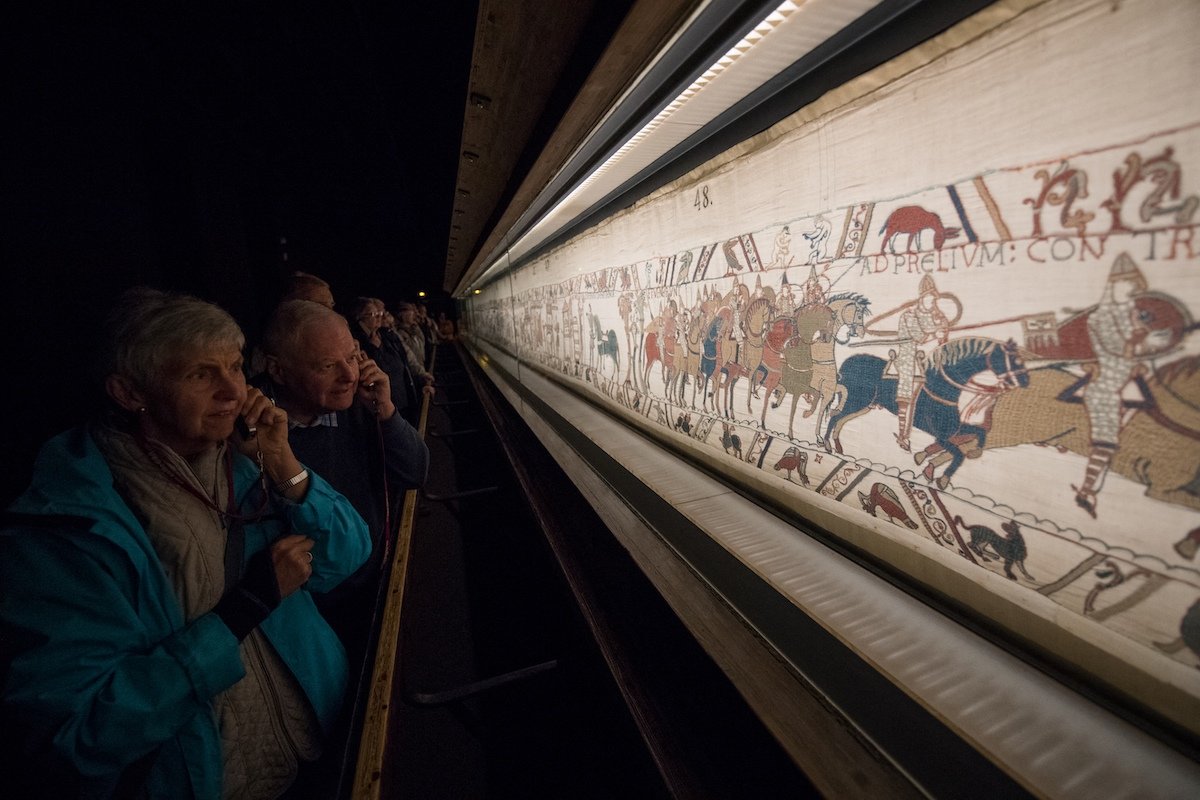
France’s Ministry of Culture has released a final report confirming that the Bayeux Tapestry sustained minor damage during its transfer from Normandy to the British Museum in London. The report, detailed by Le Figaro, marks the first time a final assessment of the tapestry’s condition has reached the media, following an initial report that made headlines in September.
Damage Found During Transfer
Eight conservationists and experts from France and England co-authored the report. Together, they described the tapestry’s overall condition as “satisfactory.” However, they also identified “two zones of fiber breakage,” new folds and tensions, and “very small” damage in areas already weakened before the journey began.
Stay connected to every major update — subscribe and follow us on the PhoenixQ website and across our social media platforms.
In addition, experts observed that “a red wool thread in an embroidered area and another from the linen background cloth have undergone a slight progression.” They also noted “slight folds and pockets” and areas of tension in both the embroidery and its linen support. Specialists believe the tapestry’s current horizontal display, in contrast to its previous vertical hang, should help ease the stretching.
The report also flags several areas requiring close monitoring, particularly ahead of the tapestry’s return to France in July 2027. These include more pronounced folds, areas of wear, and a broken thread.
Most Complete Review to Date
Experts conducted the assessment during July and August. They noted it is not possible to pinpoint exactly when the changes occurred during the transfer from Bayeux to London. Nevertheless, they confirmed that this review, which included highly detailed new photographs, is the most thorough examination of the tapestry ever completed. It surpasses two earlier assessments carried out in 2020 and 2025.
Delphine Christophe, France’s general director of heritage, told Le Figaro: “We now know the condition of the tapestry as never before, which will be useful later on.” Despite the noted damage, she described the overall assessment as “exceptional,” given the artifact’s roughly 230-foot length and 20-inch height.
A Diplomatic Loan Years in the Making
The loan faced heavy criticism in the months before the transfer due to concerns about potential harm. After three failed attempts, the loan finally succeeded through a carefully controlled ground transportation plan designed to eliminate almost all vibrations. French President Emmanuel Macron’s political commitment also proved essential, as he sought to make a strong diplomatic gesture toward the UK.
In exchange, France will receive the Sutton Hoo archaeological ship burial and the Lewis Chessmen from the British Museum. However, Le Monde’s Roxana Azimi noted that “the Sutton Hoo treasure does not resonate at all with the French public,” adding that the French “are getting objects that are certainly valuable, but not very impressive.”
British Museum director Nicolas Cullinan responded directly to that point. “Yes,” he said. “It’s very hard to beat the Bayeux Tapestry.” The nearly 1,000-year-old artifact is believed to have been made in Canterbury after William the Conqueror’s coronation as king of England in 1066. It depicts his account of the Norman Conquest, one of the most significant events in English history.