English















































New satellite data and weather records are challenging the Canadian Armed Forces’ account of the deadly wildfire that killed four soldiers at CFB Wainwright on October 17. An analysis by Global News, reviewed by seven Canadian wildfire experts, suggests the fire was larger and the weather more predictable than military officials have indicated.
What the Military Said — and What Data Shows
The Canadian Armed Forces described the blaze as a common grass fire that erupted under “uncommonly strong winds” and called the event “entirely anomalous.” Officials said the fire swept through the training grounds around 4 p.m., overtaking soldiers in as little as 30 to 60 seconds per kilometre.
Stay connected to every major update — subscribe and follow us on the PhoenixQ website and across our social media platforms.
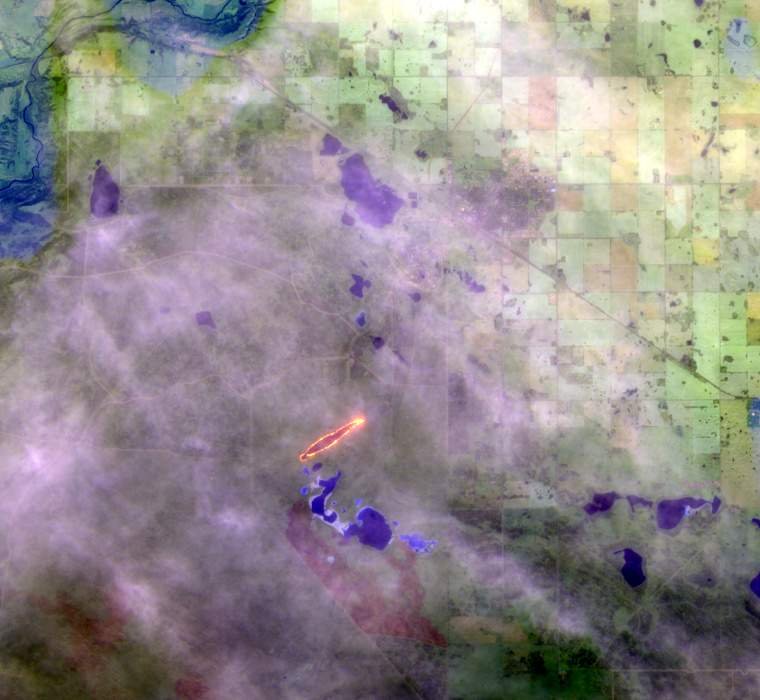
However, satellite imagery tells a different story. At 12:17 p.m., the U.S. Landsat 8 satellite captured an active fire stretching roughly two kilometres across the base’s grasslands. Wildfire expert Jen Beverly, an associate professor at the University of Alberta, estimates the blaze already covered approximately 48 hectares by noon — equivalent to about 50 football stadiums.
Meanwhile, Environment Canada had forecast a cold front bringing powerful winds since the previous morning. At 2:14 p.m. — nearly two hours before soldiers were reportedly overrun — the agency extended a wind warning to Wainwright, forecasting gusts up to 100 kilometres per hour.
“This was not unexpected given the forecast cold front, the actively spreading fire and the wind warnings issued earlier in the day,” Beverly said.
A Fire Growing Before the Cold Front Arrived
At 2:49 p.m., the NOAA-20 weather satellite detected heat beyond earlier fire locations. Beverly estimates the fire had nearly tripled in size to about 140 hectares by that point. Wildfire researcher Mike Flannigan of Thompson Rivers University agreed the fire was already highly active.
“By two o’clock that fire was running,” Flannigan said.
By 3 p.m., temperatures exceeded 23 degrees Celsius while humidity dropped below the temperature — a condition fire scientists call “crossover,” which significantly increases fire danger. At 3:10 p.m., the GOES-18 satellite recorded 76 megawatts of fire radiative power. Just twenty minutes later, that figure surged to 1,215 megawatts — a nearly sixteenfold increase — before dropping sharply. Flannigan said this indicated a major escalation as the cold front reached the training grounds.
Environment Canada recorded an 82-kilometre-per-hour wind gust at the CFB Wainwright airfield at 3:16 p.m. Temperatures then plunged more than 10 degrees within an hour.
Experts Question the Reported Fire Speed
Both the military and Prime Minister Mark Carney described flames travelling roughly a kilometre in under a minute. Three wildfire experts acknowledged that estimates made during a traumatic event may be imprecise. However, they also said the reported speed would be extraordinary.
Marty Alexander, one of Canada’s most experienced wildfire researchers, said a grass fire spread rate exceeding 60 kilometres per hour is “very highly improbable.” Researcher Cordy Tymstra noted the fastest documented Canadian grass fire he knew of averaged just 14.7 to 16.8 kilometres per hour.
Experts said the greater danger was the forecast wind shift. A shift can turn the long flank of an established fire into a rapidly advancing front moving in a new direction. “If a two-kilometre fire turns into a two-kilometre fire front, you can’t go sideways,” Flannigan said.
Questions Remain as Investigation Continues
Four soldiers died and 39 were injured, including 19 critically. Nearly two weeks after the disaster, the military’s Board of Inquiry had not yet formally convened. Officials said it could take more than a year to complete.
The Department of National Defence confirmed it made no changes to safety measures following the tragedy. CFB Wainwright’s standing orders identify August through October as a high-risk fire period and advise scheduling live-fire exercises in the early morning, when fire danger is generally lower.
Beverly said the tragedy should prompt a serious review of military fire risk procedures. “From a fire science perspective it was predictable,” she said. “There should have been information flows and procedures in place to ensure that fire behaviour was understood by those working near fire on the base.”
Maj.-Gen. Wade Rutland said the military’s investigation will be made public and that procedures will change where necessary.