English

























“Editor-in-Chief: SHAPOUR-T”
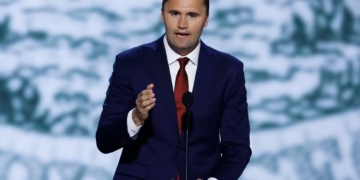
The potential victory of Zishan Memdani, a Muslim populist candidate for New York City mayor, raises a pressing question. Why are modern societies still vulnerable to hollow and manipulative slogans? Memdani, like 20th-century religious populist leaders, knows his promises of economic justice and urban reform are impossible without budgetary and institutional support. However, this awareness does not stop him. In fact, populism is not about action. Instead, it is about stirring collective emotions and creating a political myth.
From New York to Tehran 1978: History Repeats
In 1978, the Iranian people also trusted the simple and enticing promises of Ruhollah Khomeini. These promises of freedom, justice, and independence ultimately led to oppression, poverty, and cultural collapse. Moreover, leftist intellectuals and Western elites in Paris and London supported Khomeini at the time. Today, similarly, Western leftist currents defend Memdani and similar figures as the “voice of the oppressed.” However, history warns that religious populism never delivers liberation. Instead, it becomes a new tool for control and crisis creation.
The West’s Role in Nurturing Political Islam
We must not forget that the West, especially the U.S. and Britain, played a major role in fostering political Islam over past decades. For example, they provided indirect support for the Iranian Revolution and employed Islamist groups during the Cold War. All of these actions were part of a strategy to counter communism. Today, with figures like Memdani emerging in the heart of New York, the West faces a modern version of a phenomenon it once planted in the Middle East.
Religious Populism: A Global Threat
Religious populism is not merely a religious phenomenon; it is a civil and psychological crisis in modern societies. People, weary of economic inequality and political corruption, turn to charismatic leaders who speak simply and identify imaginary enemies. In Iran, the enemy was the West and the “Great Satan”; in today’s U.S., the target is the “white elite and wealthy.” The result, however, remains the same: the suppression of rational thought, the empowerment of emotions, and the transformation of religion or identity into a tool of power.
Memdani and the Harsh Reality of Promises
Memdani knows his pledges cannot be fulfilled without the city budget and Republican support. Just as Khomeini knew that promises like “free water and electricity” were an illusory dream. Yet both leveraged collective emotions to build personal and symbolic power. The problem is that society—whether in Iran in 1978 or New York in 2025—remains vulnerable to emotional and religious rhetoric.
The World in a Cycle of Repetition
Perhaps today’s modern world has returned to where Iran was 45 years ago—caught in populism that appears justice-driven but delivers only destruction and deception. Memdani is merely the latest symbol of this cycle—a cycle repeating from Tehran to Washington, from Cairo to Paris—always in the name of God, and always against reason.