English








































“By:Arash Parsa-Analyst and Researcher”
Introduction
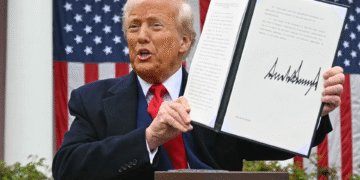
In his usual style of sudden announcements, U.S. President Donald Trump revealed a 100% tariff on almost all Chinese imports.
The move sparked new concerns about the future of global trade and economic relations between the world’s two largest powers.
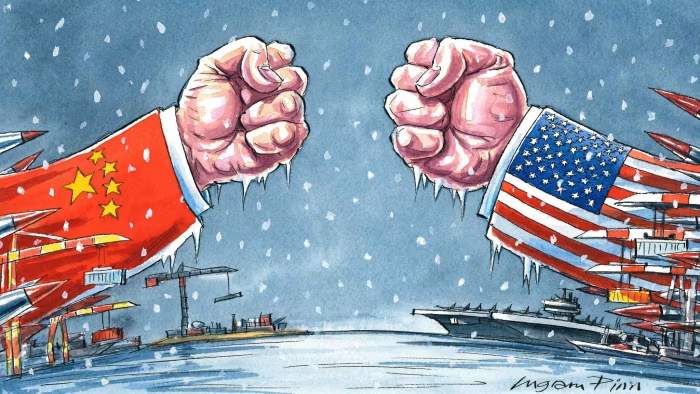
But the main question remains: Will this new trade war hurt China or America more?
Trump’s Decision and China’s Response
Trump stated that the United States will tighten import controls on Chinese products. This move followed Beijing’s recent decision to add five rare and critical minerals to its export control list. China currently produces more than two-thirds of the world’s rare earth metals.
Beijing intends to use this position as a geopolitical leverage point in ongoing and future trade conflicts.
The Importance of Rare Earths for the U.S.
Rare earth elements play a crucial role in the U.S. defense and technology sectors. They are essential in submarines, warships, stealth systems, and laser-guided weapons — the foundation of advanced U.S. military technology.
However, most of these materials are imported from China, creating strategic dependency on its main rival.
At present, the U.S. has only one active mine for these elements.
By 2024, its import dependency was extremely high:
-
100% dependence on scandium and yttrium
-
80% dependence on lanthanides
A History of Mineral Tensions
China had previously restricted exports of seven rare elements — samarium, gadolinium, terbium, dysprosium, lutetium, scandium, and yttrium — to the United States.
A similar trend continued under President Biden. After Washington imposed limits on advanced chip exports to China, Beijing responded by restricting gallium, germanium, antimony, and graphite materials.
This time, however, the restrictions are much tighter. China not only controls raw material exports but now requires licenses for exporting rare-earth magnet technologies and recycling equipment.
Beijing’s Official Position
The Chinese Ministry of Commerce stated that the new measures are not meant to stop exports, but to manage them more effectively.
The ministry emphasized that licenses will be granted for applications complying with legal standards. In other words, Beijing aims to enhance its bargaining power in future trade negotiations, not to close the export route entirely.
Tariff War: A Double-Edged Sword
Despite its dominance in rare earth production, China’s policy could backfire.
The U.S. tariffs may push Chinese exports into recession and potentially end traditional trade between Beijing and Washington.
The United States remains the world’s largest importer, but China — once its top trading partner — has lost ground.
In recent years, as Trump’s trade policies intensified, the position shifted toward the European Union, Mexico, and Canada.
The Decline of China–U.S. Trade
According to the World Trade Organization (WTO), Chinese exports to the U.S. could drop by up to 77% this year.
That means one of the largest trade relationships in the world is on the brink of collapse.
Rising tariffs and Washington’s strategy to reduce dependency on China are the main drivers of this decline.
Projections show that China’s presence in the U.S. market will continue to weaken.
China’s Challenge in Finding New Markets
Although China remains the world’s top producer and exporter, today’s conditions are far different. Beijing is seeking new markets to reduce reliance on the U.S., but the path is full of obstacles. One of the biggest issues is falling export prices.
This drop has forced many Chinese manufacturers to operate with thin or negative profit margins. While China’s trade balance remains positive, the country’s real economic growth is now at risk.
America’s New Strategy Against China
On the other side, the U.S. is not standing still.
Washington is countering China through initiatives such as:
-
Investing in rare earth mining in other countries
-
Increasing domestic production and diversifying supply chains
-
Acquiring stakes in key mining firms worldwide
These long-term policies aim to weaken China’s strategic advantage.
Although progress is slow, the plan is gradually expanding — a process that began under Trump.
Conclusion
The China–U.S. trade war has entered a new and dangerous phase.
Rare earth elements and heavy tariffs have become the main weapons in this economic conflict. China is leveraging its dominance in mineral markets as geopolitical pressure. Meanwhile, the U.S. is reducing dependency and rebuilding vital supply chains.
In the end, this trade war will have no clear winner. Both powers face deep economic, industrial, and political challenges.
Read more in PhoenixQ Political Analysis